
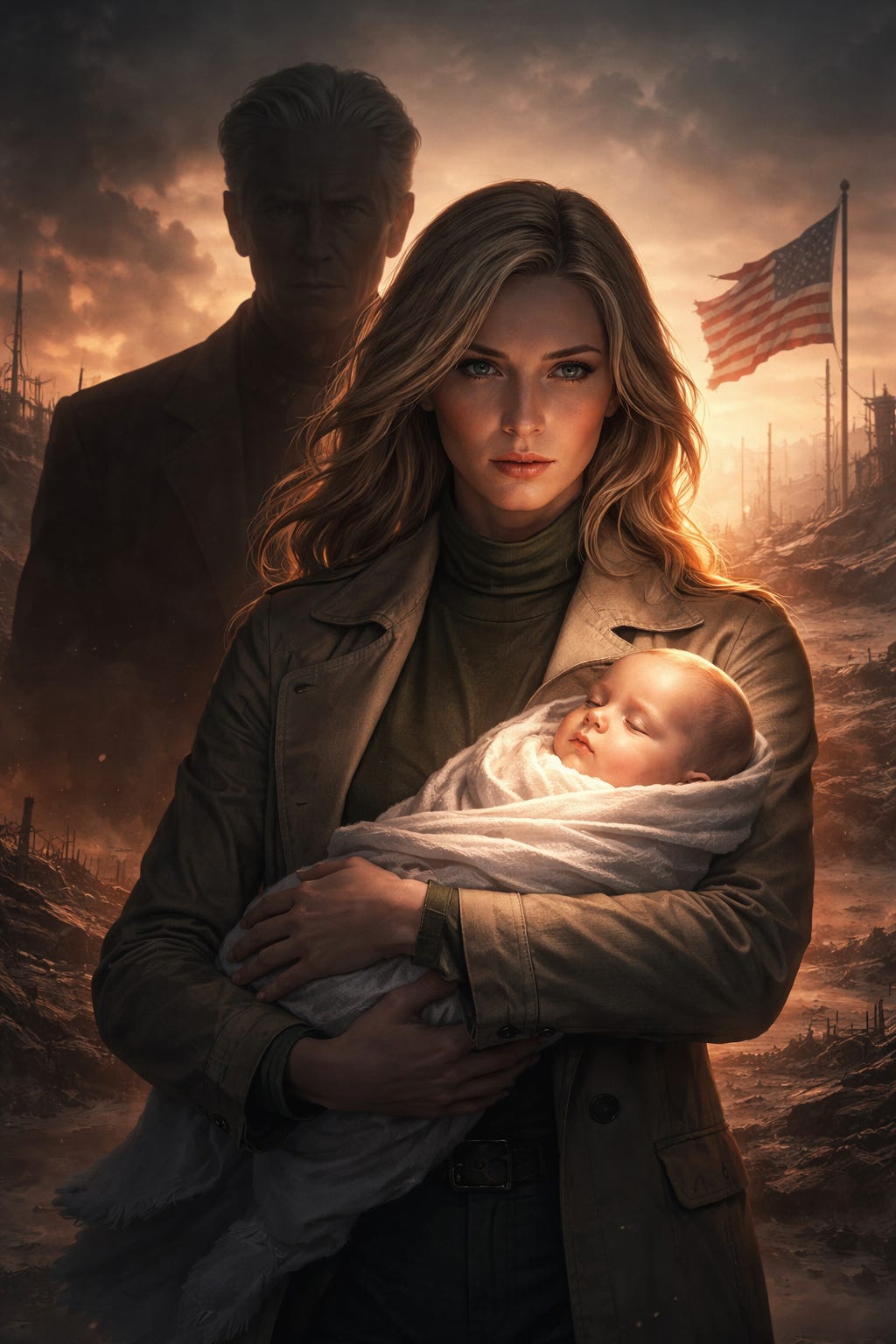
Pretoria, South Africa 1960
The light in Pretoria had a way of making everything look inevitable.
It came down clean and hard over the white-washed walls, the red earth, and the clipped hedges of the neighborhoods where order wasn’t just a preference, but rather a rule. Morning arrived bright and absolute, bleaching the sky until it lost its color. It was the kind of light that made the whole country look righteous from a distance. Up close, you just saw the fences.
Maye stood barefoot on the back veranda, her notebook pressed against her chest, watching her father. Joshua Haldeman had been awake for hours; he liked the morning before other people could get their hands on it and mess it up. In that hour, the world still looked unfinished, waiting for someone with enough intelligence to give it a proper shape. He was at a worktable under the shade awning, sleeves rolled up, sorting through maps and the little mechanical parts that seemed to follow him from room to room. He moved with the quiet, vibrating energy of a man who believed history had personally given him an assignment.
Maye adored that about him. At twelve, she hadn’t realized yet that great men usually look best from the porch.
“Maye,” he called, not looking up. She straightened her back. “Yes, Daddy?”
“Come here.”
She hurried down the steps, notebook in hand, her braid bouncing against her dress. Her sister, Kaye, had teased her about that notebook, saying she looked like a little clerk or a teacher’s pet. But Maye didn’t care. Her father said writing things down disciplined the mind and made thought visible. It kept a person from dissolving into the “softness of the crowd.” If he said it mattered, it mattered.
Joshua glanced at the notebook as she reached him and gave a tiny nod of approval. It was a small gesture, but it filled her with enough warmth to last the day. “Good,” he said. “You brought it.”
“I always bring it.”
“Yes,” he replied, finally looking at her. “That’s why you’re useful.”
He didn’t mean it cruelly. To Joshua, being “useful” was the highest form of praise. Competence was how you showed love in this house. Maye had already figured out that to get his full attention, she had to meet him where he lived: in the architecture of ideas.
On the table lay a map of Africa, another of North America, and a stack of typed pages clipped together so precisely they looked bolted. Maye could smell machine oil and the old leather of his satchel. Joshua tapped a finger on the map. “Tell me,” he said, “what is the central problem with democracy?”
Maye didn’t have to think; they had covered this. “It gives equal weight to unequal minds.”
Joshua’s mouth twitched—not quite a smile, but the closest thing he had. “And?”
“It rewards emotion over intelligence. It picks popularity over design.”
“Good.” She tried to keep a straight face, but she felt the pride spreading through her, hot and heavy. Kaye didn’t share the feeling.
From the doorway behind them, a sandal scraped against the tile. Kaye stood there in her house dress, arms folded, her face still puffy from sleep. Even though they were twins, Kaye always felt like she belonged to a different season. Where Maye leaned into their father’s world, Kaye pulled back.
“You didn’t call me,” Kaye said.
Joshua didn’t turn around. “You were sleeping.”
“So?”
He finally looked at her. “So one of you was ready.”
Kaye’s face tightened. It wasn’t laziness or defiance; it was just the look of a child who was tired of having to audition for a seat at the table. Maye felt a quick sting of guilt, followed by a rush of relief that, once again, she was the one he wanted to talk to.
Joshua went back to his papers. “If you want to learn, Kaye, then come prepared.”
Kaye stayed there for a second, the silence growing heavy between them. Then she muttered something and went back inside.
Maye kept her eyes on the notebook. Joshua didn’t seem to notice the tension… or maybe he just didn’t think it was worth his time. “Now,” he said, adjusting a page. “Where were we?”
“You said politics is a disease,” Maye prompted.
“Yes.” He put a finger on North America. “It’s a stage of civilization, not the destination. People think voting is freedom because they’ve been trained to mistake choice for wisdom. But systems don’t care about any noise. Power grids don’t care about speeches or feelings. The world is ruled by physical realities, not slogans.”
Maye wrote it all down, her pen flying.
“Your generation will understand that better than mine,” he said, his voice softening slightly. “We were early. The world wasn’t desperate enough yet. People still had too much romance in them, too much faith in politicians.” He looked past the yard, toward the horizon. “But that faith is dying. It has to.”
A breeze shifted, carrying the distant sound of a car and a barking dog. Pretoria in the morning could feel peaceful if you ignored the reality of how that peace was maintained.
Beyond their walls, the city was a grid of hard lines. In 1960, the racial divide was hard to ignore, as it was the law. The white minority population held total control over the other the majority population. Black workers moved through these neighborhoods like ghosts, their lives governed by “pass books” and permissions.
Maye didn’t understand the politics of it yet, but she saw the surfaces. She knew certain people stayed at the gate. She also knew the adults had been whispering since the massacre at Sharpeville, where dozens of protesters had been shot. The papers were full of words like “agitator” and “containment.” But her father never sounded scared. He just sounded impatient.
“The world,” Joshua said, “is going to get meaner before it gets smarter.” Maye looked up. “Why?”
“Because failing systems panic.” He leaned against the table. “When people realize their way of life is falling apart, they cling to the old rituals. They hide in their tribes, their races, their religions. They get emotional and primitive.”
Maye thought about that. Joshua made everything sound like a proven equation. He didn’t rant, rather… he organized.
“And us?” she asked. A rare softness touched his face. “We build what comes after.” Inside the house, dishes clattered. Her mother called for breakfast. Joshua ignored it. When he was in the middle of an idea, the rest of the house had to wait. He took the notebook from Maye, scanned her notes quickly, and handed it back.
“You listen better than most adults,” he said. It was a small sentence, but it felt like a coronation.
At the door, Kaye had come back, half-hidden in the shadows of the kitchen. She was watching them with that naked, miserable look children have before they learn how to hide their heart. She just wanted him to say one thing like that to her. To be in the orbit instead of watching from the dark. Maye saw her and looked away.
“The world won’t be saved by the masses, Maye,” Joshua said, still looking at the yard. “It’ll be saved by the people willing to see it as it is, not as they wish it to be.” He pressed his hand against the notebook on her chest. “Maybe not in my lifetime. Maybe not even in yours. But one generation starts the work, and the next finishes it. That’s history.”
Maye nodded, and then said, “I’ll make you proud, daddy, promise. Please teach me as much as you can.”
Inside, Kaye turned and disappeared before they could see her go. Joshua never noticed. Years later, Maye would remember the heat of that light and the smell of the red dust. She’d remember the weight of that notebook and her father’s hand.
The road to school was not long, but in Pretoria, distance was rarely measured in steps. It was measured in boundaries… some made of stone, others made of the way people looked at you.
Maye and Kaye walked side by side beneath a sky that had already turned a pale, unforgiving white. Their satchels tapped a rhythmic, hollow beat against their hips, and their white socks were already beginning to gather a fine coat of red dust at the ankles. The morning had warmed with a sudden, aggressive heat. Sunlight slid across the pavement in clean, blinding sheets, catching on the whitewashed walls and the polished chrome of the motorcars parked in driveways. From a distance, the neighborhood looked so orderly it could be mistaken for a moral achievement.
Up close, it was a landscape of gates, warnings, and the heavy silence of routine.
The black workers moved along the edges of the scenery, never quite merging with it. A gardener in a faded hat clipped at a hedge with his head down, his shears making a sharp, metallic snip-snip that sounded like a clock ticking. A woman in a plain, starched dress stepped off a side path, carrying an empty basket against her hip; she didn’t look at the girls, and they didn’t look at her. It was a practiced invisibility.
Further down, two policemen stood near an intersection. They had the loose, easy posture of men who knew the law was a garment tailored specifically for them. They didn’t have to move to be felt. Nobody lingered near them. Even Maye, who was only twelve and still trying to decipher her father’s complex charts, understood that the air around those men was different; thicker, colder. Kaye kicked at a stone, sending it skittering into a drainage grate. “He likes you better.”
Maye didn’t look away from the road ahead. “That’s not true.”
Kaye turned her head, her expression weary in a way that didn’t fit a child’s face. “You don’t have to do that with me, Maye. We’re the same age. I was there for the same breakfast.”
“Do what?”
“Pretend he’s just ‘talking’ to you. He’s training you. He looks at me like I’m a broken part he can’t find a use for.”
Maye gripped the leather strap of her satchel more tightly. The heat sat on her shoulders like a physical weight. “He just thinks you don’t listen. He likes it when people listen.”
“I listen,” Kaye said flatly. “I just don’t think he’s a prophet. He’s just a man who’s angry at the world for being the way it is.”
For a few minutes, neither of them spoke. Their shoes clicked against the pavement, then softened as they reached a stretch of road where the tar had been worn down to the grit. Somewhere behind a high wall, a radio was playing a low, tinny jazz tune. A dog barked once, a sharp, lonely sound that echoed off the concrete and then died.
Ahead of them, a group of boys was cutting across the street. They were older, maybe fourteen, moving with a jagged, frantic energy. They were laughing in sharp bursts, the kind of noise that usually preceded trouble. One boy, lean and wiry with a shock of blond hair, glanced in their direction. Maye barely had time to register the look in his eyes—not hatred, exactly, but a bored sort of malice before he shifted his course. It happened with a sudden, sickening efficiency.
A shoulder shoved into her, a foot hooked low against her shin.
The world tilted. Maye’s satchel slid from her shoulder, the strap burning her neck, and she went down hard. She hit with one knee and both hands, the grit of the road grinding into her skin. The notebook flew out of the bag and thudded against the dirt. For a second, the sun seemed to flare brighter, and she felt nothing but the shock of the impact, as if the earth itself had risen up to strike her for being too confident in her stride. Then the sting arrived. Kaye stopped, her eyes wide. “Maye!”
The boy was already several paces away, looking back over his shoulder. He laughed… a light, fast sound. It was the laugh of someone who knew there would be no consequences. His friends shouted something she couldn’t catch, and then they were gone, a blur of khaki and motion disappearing around the corner.
Maye stayed frozen for a heartbeat, her palms pressed into the dirt. Her knee burned with a white, hot intensity. She could feel the tiny grains of sand embedded in her skin. But the humiliation felt worse than the scrape; it was the feeling of being made small in the open air, under the clean morning sun, without a single word of warning.
Kaye crouched beside her, reaching out a hand. “Are you hurt?” Maye didn’t take the hand. She snatched up the notebook first, blowing the dust off the cover with a desperate, shaky breath. “No.”
“You’re bleeding, Maye. Look at your sock.”
“I said I’m fine.” Her voice was sharper than she intended, a jagged edge that made Kaye flinch back.
Maye stood up too quickly, her head swimming for a second. She could feel her face burning, a deep, hot flush that felt like a fever. She looked down the empty street where the boy had vanished, and the void he left behind made the sting sharper. There was no one to fight, no one to argue with. Just the red dust and the silence.
Two older white women further down the pavement had stopped to watch. One of them gave the girls a brief, pinched look, the kind of look one gives a spilled glass of water, before murmuring something to her companion. They moved on without asking if she needed help. A man loading crates into a truck nearby didn’t even turn his head.
In Pretoria, if you fell, you were expected to get up quietly. Kaye reached out and tried to brush the dirt off Maye’s dress. “Why would he do that? We didn’t even say anything to him.”
Maye didn’t answer. She was staring at the dark, wet smear beginning to spread through the fabric of her white sock.
“Daddy’s going to notice,” Kaye whispered. That was what got Maye moving.
They started walking again, though Maye had to limp slightly to keep the skin from pulling. Her knee pulsed with every step, a dull throb that synchronized with the beating of her heart. The sting in her palms had turned into a raw, weeping heat. But more than the pain, she felt a shift in the way she saw the road. It no longer felt neutral. It didn’t feel like a system of transit.
By the time the school building appeared, a pale, rectangular block behind a high wire fence, Maye had retreated into the silence she used when she was trying to process an insult too large for her to handle.
Children were streaming through the front gate, uniforms pressed, shoes gleaming. A bell hadn’t rung yet, but the morning was already sorting itself into lines. The geometry of the school was supposed to represent certainty and education, but to Maye, it just looked like another set of bars.
Kaye looked at her sideways. “Are you going to tell him what happened? About the boy?” Maye looked down at the scratched cover of her notebook.
“No,” she said.
But she knew better. Her father would analyzed it. He would see the torn skin on her palm and the ruined sock, and he wouldn’t see a schoolyard prank; he would see a failure of awareness. He would file it away into one of his lectures about the “masses” and the “primitive” nature of those who lived by emotion. He would use her pain as a data point. Maye knew better than to ever show emotion, especially around her father.
Maye didn’t have the words for that yet. She only had the feeling of the red dust in her wounds. The two girls walked through the gate, blending into the flow of white shirts and blue tunics. Inside, the desks waited in neat, unfeeling rows. Chalk dust floated in the sunlight. Voices echoed off the walls with the brittle energy of children trying to settle into obedience.
Maye tightened her grip on the notebook, tucked it under her arm to hide the scuffs, and followed her sister toward the classroom. She carried the sting of the road in her skin, but beneath it, something harder was beginning to take shape. She was learning the most important lesson Pretoria had to offer: the system only protected you if you never, ever stumbled.
The classroom smelled of stale chalk, floor polish, and the heavy, trapped heat of thirty bodies trying to sit still in wool uniforms.
Rows of wooden desks, scarred by decades of bored children with penknives, faced a blackboard already dusted pale from the morning’s first equations. Sunlight cut through the high, arched windows in rigid white bars, laying itself across the floorboards with a geometric precision that made the room feel like a cage made of light. At the front, Mrs. van der Merwe moved with a forceful, rhythmic energy, her chalk clicking against the slate as she wrote out algebraic expressions.
Maye had solved all three before the woman even reached the end.
She sat with her pencil balanced perfectly between her fingers, staring at the board with the dull, thrumming ache of someone being forced to crawl after learning how to sprint. Around her, the room was a symphony of struggle, with chairs creaking, and heavy paper rustled. A boy near the window was erasing so hard the friction was audible across the room. Two rows over, Kaye was hunched over her desk, her brow furrowed in that familiar, determined look of hers. Kaye struggled and paid attention, while Maye was building kingdoms in her mind.
For Maye, that was the exhausting part. The numbers didn’t require effort; they were a language she had spoken since birth. They settled into patterns almost before she could process them, each step sliding into the next with an obviousness that felt like an insult. There was no thrill in the “eureka” moment because there was no mystery to solve. She was beginning to realize that being the smartest person in a room didn’t feel like power… it felt like waiting for everyone else to catch up to a conversation you’d already finished.
Mrs. van der Merwe turned from the board, dusting her hands on her skirt. “You should all have at least the first one finished by now. If you haven’t, you are falling behind the schedule.”
The teacher’s eyes swept the room and landed on Maye, whose page was conspicuously still.
“Miss Haldeman.”
Maye straightened. “Yes, ma’am?”
“Since you appear to have found something more interesting to look at than your own work, perhaps you would like to come and show the class your method for the third equation.” A few students shifted. A boy in the back let out a quiet, mocking hiss of air. Maye felt the familiar, cold prickle of irritation. She didn’t mind being right, but she hated being used as a yardstick to measure the others’ failure.
She walked to the front, the floorboards groaning under her shoes. She took the chalk and wrote the answer out with a brisk, mechanical efficiency. She skipped three intermediate steps—the “showing your work” parts that felt like a waste of lead and time—and finished with a sharp, final dot. The teacher watched in a heavy silence.
“Yes,” Mrs. van der Merwe said, her voice tight. “Correct. Though in the future, Miss Haldeman, you might remember that a classroom is not merely for arriving at a destination, but for walking the road taken together.”
Maye handed the chalk back, her fingers white with dust, and visible annoyance. “Well maybe they need to keep up instead of discouraging me for being smarter.”
A ripple of nervous laughter went through the desks. Mrs. van der Merwe’s expression didn’t change, but her jaw tightened. “And yet, you are still required to walk it at the same pace as the rest of the world. Return to your seat.”
Maye walked back, the reprimand stinging not because it was harsh, but because it was so small. This was the system: excel, but not too much. Be brilliant, but stay in the lines. It was a world that demanded excellence only as long as it remained humble and obedient.
She lasted exactly five minutes of the next lecture.
While Mrs. van der Merwe was hunched over a desk in the front row, untangling a student’s confusion, Maye slipped her hand into her satchel. Her fingers found the familiar, cool texture of the black notebook.
It was worn smooth at the corners. Across the front, in her father’s aggressive, blocky script, was the title: THE TECHNATE.
She kept it low, shielded by the lip of her desk. She opened it to a page near the center, where the penciled notes were so dense they seemed to vibrate. Joshua Haldeman didn’t write like other people; his handwriting was a series of hard, slanted strikes, impatient with the limitations of the page.
She found the passage she had been memorizing:
The Price System is a legacy of scarcity. It is a ghost operating a modern machine. In the old world, value was determined by debt and labor. In the new world, value must be determined by energy. We need to find a way to seize the means of production.
Maye’s eyes moved down the page, skipping over the technical specs for energy units and landing on a paragraph underlined so heavily the pencil had nearly torn through the paper:
The transition will not be a choice. It will be a physical necessity. As the old empires exhaust their credit and their blood, the managers of the machine will step forward. The public will continue to play at politics; they will vote, they will shout, they will cling to flags, but the switches will have already moved. They will call it democracy while the Technate runs the lights. The military industrial complex has accelerated technological advancement. We’ve mastered the rudimentaries behind artificial intelligence.
Maye felt a strange, electric hum in her chest. Outside the window, Pretoria was a city of rigid laws and racial tiers, a place where everything was supposedly “ordered.” But her father’s notebook suggested that the order was an illusion… a temporary theater performed by people who didn’t understand that the real power was moving toward the engineers, the accountants, and the planners.
She turned the page to a rough diagram. It was a map of a world divided not by nations, but by “Technates”; continental units governed by functional competence rather than political whim.
The future belongs to the civilization that controls energy, production, and narrative simultaneously. This will be America, once its old mythology of the pioneer dies and is replaced by the reality of the technician. Oil rich nations will have leverage unless we replace oil, which seems unlikely. Venezuela will be easy to take. The Soviets will play ball considering their massive oil reserves. But the Middle East is the crown jewel. With the United States funneling billions in military aid to their greatest ally, the chaos being created will allow us to maintain control.
“Miss Haldeman.”
… Iran revolution, install a radical Islamic government…
The notebook snapped shut with a sound like a pistol shot.
The classroom had gone deathly quiet. Maye looked up slowly. Mrs. van der Merwe was standing right beside her desk, her shadow falling across the open satchel.
“What,” the teacher said, her hand extended, “is that?”
Maye felt the heat rise in her neck. For a split second, she thought about shoving it back into the bag, but her father had taught her that guilt was for those who lacked conviction. She placed the notebook in the teacher’s palm.
Mrs. van der Merwe looked at the cover. Her eyebrows twitched at the word Technate. She opened it, her eyes darting across her father’s feverish, brilliant notes. She read for ten seconds, then twenty. A strange look crossed her face—not anger, but a flicker of genuine discomfort, as if she had accidentally touched something that was still plugged in.
“This,” she said, her voice dropping, “is not algebra.”
A few kids snickered. Maye didn’t blink. “It’s physics, ma’am. Of a sort.”
Mrs. van der Merwe closed the book and set it back on the desk. She didn’t confiscate it. She looked at Maye with a mixture of pity and something that looked very much like fear.
“If ordinary work bores you, Miss Haldeman, that does not place you above the rules of this room. Your father’s... theories... are no excuse for a lack of discipline.”
“It’s not a theory,” Maye said quietly. “It’s a design.”
The teacher held her gaze for a long moment, then turned and walked back to the blackboard without another word. The spell was broken, the class rustled back to life, but the air felt different now.
Maye placed her hand over the notebook, her palm resting on the word Technate.
Across the room, Kaye was staring at her. Her sister’s face was pale, her eyes wide with a look of profound unease. It was the look of someone who realized they were sharing a room with a stranger.
Maye didn’t smile. She just opened her textbook to the page they were supposed to be on, hiding the black notebook beneath it, and began to wait for the world to catch up.
The dining room was bathed in the glow of a low-hanging amber fixture that seemed to sharpen rather than soften the room. The light hit the polished wood and the heavy silverware with a clinical precision, and the steam from the roast rose in thin, disappearing wisps. Outside, Pretoria was a blur of violet dusk, the day’s heat still radiating off the brick walls. Inside, the house was governed by a different climate: silence, discipline, and the unspoken rule that anything worth saying should be measurable.
Joshua sat at the head of the table. He didn’t just sit but rather he presided. He looked at his home the way an engineer looks at a blueprint; scanning for a loose connection or a structural flaw. To his left, his wife moved with the quiet, practiced grace of a woman who knew that household peace was a matter of timing and breath control. Maye sat to his right, her back a straight line. Opposite her was Kaye, who was picking at a loose thread on her sleeve, her shoulders hunched as if she were trying to occupy as little space as possible.
The only sounds for a long time were the rhythmic clink of forks and the soft drag of chairs on the rug. Then, Joshua set his napkin down. The movement was a signal.
“Let’s not waste the evening,” he said, his voice level. “You’ve both spent eight hours in a classroom. Let’s see if any of it was actually useful.” Kaye’s eyes stayed on her plate. Maye looked up immediately.
“Maye,” Joshua said, leaning back. “The Treaty of Versailles. What was the real failure?”
Maye didn’t blink. “It ended the fighting but guaranteed the war. It focused on moral blame rather than physical reality. By stripping Germany of its resources and its pride, it made a populist reaction inevitable.”
Joshua gave a single, slow nod. “And the political cost of shame?”
“Hungry people are dangerous,” Maye said, “but humiliated people are desperate. Shame makes them look for a savior who doesn’t mind getting his hands dirty.”
A flicker of something, not quite a smile, but a recognition of competence, crossed Joshua’s face. He turned to Kaye.
“And you. Why do governments that are falling apart lean so hard on ceremony?”
Kaye looked up, her expression strained. “Because… they want to look like they’re still in charge?” Joshua waited. The silence stretched until it felt heavy.
“Because people are scared of change,” Kaye added, her voice dropping.
“Yes,” Joshua said, his tone flat. “And what do scared people do?”
Kaye opened her mouth, looked at Maye for a split second, and then looked back at her plate. Maye felt the answer vibrating in her own throat. She could see the logic of it, the way people under pressure always defaulted to the most primitive settings.
“Well?” Joshua prompted. “They panic,” Kaye said, her voice trembling.
“They cling,” Maye corrected softly, almost to herself. “They go back to the basics. Tribal mentality. They stop thinking and start reacting.”
Kaye’s fork hit her china with a sharp, ringing crack.
“Of course,” Kaye snapped, her eyes suddenly bright with a mixture of anger and hurt. “Of course you have the perfect word for it.”
Their mother looked up, her expression unreadable, but she didn’t speak. “Kaye,” Joshua said.
“No!” Kaye pushed back from the table, the chair legs screaming against the floor. “Why do you even bother asking me? It’s not even a conversation. It’s always a test with you, and you only care if the answer sounds like something you’d say. You don’t want us to be people. You want us to be data points.”
“Sit down,” Joshua said. It wasn’t a shout. It was worse… it was a demand.
“No.” Kaye was shaking now. She looked at Maye, and the jealousy there was buried under something much more painful. “You can have him, Maye. You can have the maps and the notebooks and the ‘intelligence units.’ I’m going upstairs.”
She turned and ran, her footsteps thudding up the stairs. A door closed; not a slam, but a firm, final click that seemed to echo through the entire house.
Silence settled back over the table, but it was jagged now. Joshua picked up his knife and went back to his meal as if the interruption were no more significant than a fly in the room. He chewed, swallowed, and then looked at Maye.
“That,” he said, “is a failure of discipline. Emotion is a fuel, Maye, but it’s a terrible pilot. If you let it think for you, you’ve already lost.”
Maye looked at the empty doorway, then at her father. “She thinks you love me more.” Joshua didn’t look up from his plate. “Love is a word for poets and people who want excuses. I value seriousness. I invest in what works.” Their mother set her glass down. “Joshua, that’s enough.”
“Is it?” He finally looked at his wife. “Should I lie? Should I tell her that her feelings carry the same weight as a well… reasoned argument? The world won’t tell her that. The world will just break her.”
The kitchen door swung shut behind their mother as she left to clear the first course. The room felt smaller then, stripped down to just the two of them. “Now,” Joshua said, his voice dropping an octave. “You had a question about automation.”
Maye straightened her posture. The sting of Kaye’s exit was still there, but the pull of her father’s focus was stronger. “In school, they say machines just replace workers. But you talk about it like it’s a change in the species.”
“It is,” Joshua said. “For thousands of years, the world was built on the backs of people who had to be told what to do. But once a machine can coordinate production—once it can do it faster and without the need for a ‘Price System’—the old power structures become obsolete. They become a drag on the engine.”
Maye thought about the diagrams. The “Energy Units” replacing the “Dollar.”
“And America?” she asked. “You’ve been talking about it more lately.” Joshua looked toward the window. The glass reflected the room back at them, a ghost version of their dinner.
“America is a grand experiment that is currently hollowing itself out,” he said. “They still believe in the myth of the individual, but the scale of their industry has already outgrown that myth. They have a Constitution designed for farmers, but they are running a continental machine. Eventually, the friction will become too much.”
“And then?”
“And then the technicians take over. Not by a coup, but by invitation. When the politicians can no longer keep the lights on or the shelves full, they will hand the keys to the men who can.” He looked at her, his eyes sharp and clear. “It’s already beginning. There are people in Washington, in the labs, in the boardrooms, who have quietly stopped believing in the old slogans. They are preparing the transition.”
Maye felt a chill that had nothing to do with the evening breeze.
“The Technate,” she whispered.
“The Technate,” he agreed. “It won’t be a kingdom or a republic. It will be an operational reality. Most people won’t even realize the world has changed until the new system is already the only thing keeping them alive.”
Maye nodded, her mind already filing the words away. Upstairs, the house was silent. Her sister was somewhere in the dark, crying over things that couldn’t be measured. But down here, under the amber light, Maye felt a strange, cold sense of belonging. She wasn’t just a daughter; she was a witness to the design.
And as her father reached for his glass, she realized that purpose felt a lot more like armor than love ever did.
“Father.” Maye asked her dad a question. “Why is this necessary?”
Joshua became stoic, “Imagine you have the cure for cancer. Everyone knows the cure, and everyone knows how to obtain it… but what if the President these maggots vote in was voted into office simply because of their gender? Their skin color? Things that do not matter.”
Maye was tempted to take notes, but she’d rather listen as if she’s being preached gospel.
“This President, however, refused anyone to get the cure for cancer. Now the people get angry and they want retribution, however they blame the side that wanted to give them the cure for now holding them from obtaining it.” Joshua took a sip from his cup.
“The two-party system is easy to manipulate when you allow everyone to vote. Not being able to pass policy simply because people hate that side. So they vote against their interests, while behind the scenes.” Joshua paused. “The technocrats are hard at work.”
Maye paused, processed what she had heard, and agreed with what her father said. “America has an election coming up, and it looks like the young looking one… I forgot his name, is probably going to win.”
This caused Joshua to show a bit of anger. He knew the way the American election was going, and if they allowed John F. Kennedy to take office, he has the potential of stalling the Technate. “He’s a enemy. He cannot be influenced. He’s an idealist, pro-American… anti-imperialism. We are watching him very closely.”
Maye could have listened to her father for hours, but it was getting late and she had school in the morning. Young Maye was heavily influenced by her father’s ideals, and as she would grow, she would become obsessed with the idea of an American Technate.
She would carry this legacy on to her children as if it were destiny. One of her children would become as obsessed with the idea of a new government, and gets the opportunity to fulfill the destiny his father bestowed upon his dynasty.
Her son would bring the world to its knees, and the world will smile as he does it.
This chapter follows Maye Haldeman in 1960 South Africa as she is drawn deeper into her father Joshua’s worldview while apartheid hardens around her. At home in Pretoria, Joshua singles Maye out as the daughter most worthy of his attention, praising her intelligence, quizzing her on politics and history, and treating her less like a child than a protégé, while her twin sister Kaye grows increasingly hurt and resentful of being left outside that orbit. On the walk to school and in the atmosphere around it, the chapter makes clear that apartheid is not just a law but an architecture of everyday life, shaping the streets, the silences, and the way people move through the world. In class, Maye’s advanced mind leaves her bored and alienated, and instead of focusing on schoolwork, she secretly reads Joshua’s notebook, The Technate, where she absorbs his ideas about energy, automation, wealth transfer, and the eventual rise of a technocratic order centered in America. By dinner, the family tension erupts when Kaye accuses Joshua of favoring Maye for being smart, storms upstairs, and leaves Joshua to coldly lecture Maye that uncontrolled emotion is weakness. Once Kaye is gone, Joshua speaks more openly to Maye about automation, the future transfer of power from labor to technical governance, and his belief that America’s constitutional myth will eventually be hollowed out from within, making way for the Technate. By the end of the chapter, Maye is no longer simply a bright child eager for approval, but a girl beginning to equate purpose, discipline, and her father’s ideology with belonging itself.
‘THE TECHNATE’ Prologue | 1 | 2 | 3 | 4 | 5 | 6 | 7
Amir’s story follows a struggling family entering 2020 as financial strain, a deteriorating home, and emotional distance begin to weigh on his marriage, all while early news of a mysterious illness sparks his suspicion of hidden agendas; the narrative then shifts to a quiet but calculated conversation in the White House where leaders see COVID-19 not just as a crisis but as an opportunity to consolidate power, wealth, and public compliance, before returning to Amir as the pandemic transforms everyday life into a tense, divided landscape where people enforce rules on each other, fear reshapes behavior, and his family fractures over trust, vaccines, and survival, ultimately leading Amir to quit his job due to health risks and reluctantly take the vaccine, all while sensing that something larger and more controlled may be unfolding beneath the surface of what the public is told.