
Snellville, United States, December 2019
By December of 2019, the house still didn’t feel like home. Amir tried to tell himself that was temporary, that what they had bought was a great investment opportunity. He had said as much to Clara when they signed the papers, said it with the confidence of a man trying to sell a dream before the drywall and busted concrete had a chance to speak for themselves. The market had been soft, softer than it had any right to be in an area like this, and Amir had pounced on it as if he were the only man in Georgia capable of recognizing destiny when it was hiding under warped floorboards and a failing foundation.
Before they finally purchased the house, every other place they looked at seemed to vanish the moment it hit the market. Sometimes a home would already be under contract while they were still standing in it. Real estate in America had reached levels Amir had never seen before, and people were jumping on every opportunity. He figured if this purchase had the liquidity he expected, he might eventually be able to buy another and do what investors called house hacking. Clara, however, was not as enthused, nor did she appreciate the gamble. She had begun to drift away slowly, something Amir tried his hardest to prevent. Maybe she just doesn’t understand the potential, he would tell himself.
He told her they would fix it slowly. He told her the neighborhood alone made it worth it. He told her that in a few years housing prices would surge and they would look back on the purchase as the smartest thing they had ever done. At the time, Clara had wanted to believe him. Now every crack in the driveway, every draft that rolled up through the basement floor, every awkward inconvenience of the place felt like physical proof that she had been talked into misery by a man who always had another plan and never enough money to survive the last one.
The incline of the driveway made pulling in after dark feel like parking on the side of a hill. Parts of the concrete had crumbled into jagged sections that collected rainwater and dead leaves, and there was still no decent way into the backyard unless one of them wanted to take the long route around the side through a narrow patch of uneven ground that turned to mud whenever it rained. The basement was worse. No insulation under the floor meant the cold climbed upward through the house in a way that never really left, a quiet chill that settled into the core and stayed there.
Clara hated that part most. She said it made the whole house feel damp even when it wasn’t, cursed in spirit. Amir always answered the same way, that cosmetic flaws and deferred maintenance scared other buyers away and that was exactly why they had gotten it so cheap. The logic remained sound to him even as the house itself seemed to resent being explained.
Work came and went, and Amir looked forward to seeing his family. He came through the front door a little after six with a cough he tried to bury in his sleeve before anyone noticed. It had been nagging him all afternoon, light and dry, the kind of cough that seemed harmless enough to dismiss but annoying enough to keep returning just when he forgot about it.
Outside, the air had turned sharper over the last week, a damp winter cold that slipped under jackets and made every inhale feel slightly metallic. Georgia weather had always been erratic. One week it was mild and forgettable, the next it was raw wind tunneling through every parking lot and storefront in town. It could rain with the sun still out and threaten snow by midnight.
He arrived home with no traffic, something he appreciated. He shut the door behind him, rubbed at his throat, and tried to leave the day outside with his shoes. The first thing he heard was Sofia singing to herself somewhere in the living room, not really singing a song so much as inventing one from scraps of words and melody that only made sense to her.
She was five now, old enough to talk with confidence, old enough to ask questions in clusters, old enough to fill silence with imagination whenever the adults in the room seemed determined to let it thicken. Eli was two and had brought with him a different kind of gravity when he was born in 2017, the dense little orbit of a toddler who still moved through the world like it existed solely to be pulled apart, climbed on, or tasted.
Sofia had taken to being a big sister with the uneven pride of a child still deciding whether sharing attention was noble or infuriating, and most days she drifted between tenderness and territorial outrage depending on what Eli touched. She spotted Amir first and came running in socks, sliding halfway across the hardwood before catching herself on the edge of the couch.
“Daddy,” she said, smiling as if she had been waiting at the window all day, “Eli tried to eat a crayon and Mommy said his brain is already colorful enough.”
Amir laughed, tired enough that the sound came out softer than usual. “That sounds about right.”
He crouched and opened his arms, and Sofia ran into him, warm and light and moving faster than his body expected. He kissed the top of her head, breathing in the smell of shampoo and whatever sweet snack she had gotten into earlier.
“What song were you singing?”
She pulled back with exaggerated seriousness. “It’s not a song yet. I’m still making it.”
“Oh,” he said, nodding as if this were a matter of artistic process that deserved respect. “My mistake. Didn’t realize I was standing in the presence of greatness.”
“I’m serious,” she said, then grinned because she knew he was teasing. “It’s about a bird and a princess and a haunted pizza place.”
“A hauntingly original concept.”
She squinted at him. “What does that mean?”
“It means I think you’ve got a hit on your hands.”
She accepted this with a solemn nod that lasted all of two seconds before she grabbed his hand and tried to pull him toward the living room to hear the unfinished masterpiece. Over her shoulder he could see Clara in the kitchen, not looking at him, wiping down the counter with the methodical force of someone cleaning more for control than for cleanliness.
Her hair was tied back. She wore that expression she had been wearing more and more lately, not exactly anger, not exactly sadness, but a kind of steady inward withdrawal, as though she had begun rationing herself around him. He gave her a small smile anyway.
“Hey.”
She glanced up. “Hey.”
No kiss. No softening. Just the word, flat and practical. He felt it land without showing that he did.
At dinner Sofia did most of the talking, which suited everyone fine. Eli smashed bits of food into his tray and babbled in bursts that sounded convinced of their own importance. Amir played along when Sofia declared she was old enough to have her own job. He asked what kind, and she told him she wanted to be a singer, a doctor, and a mermaid, maybe all at once if the hours worked out.
“That sounds ambitious,” he said, “but not impossible.”
Clara almost smiled at that, and for a moment he saw a flicker of the woman he used to come home to, the one who leaned into him without thinking, the one who could make a bad apartment feel like a sanctuary simply by being in it. But the moment passed. It usually did.
Debt had become the third presence in the marriage. It was there in the way Clara asked questions now, as if every purchase carried the possibility of betrayal. It was there in the way Amir explained himself before she even asked, already anticipating the sigh, the look, the arithmetic disappointment. Several of his business plays had gone sideways, some from bad timing, some from bad luck, some from the kind of overconfidence that never announces itself until after the damage is done. He kept telling her he would handle it. He kept believing that too. He had always believed he could out-think the next crisis if given just a little more time. The problem was that time had started charging interest.
Later, after the kids were down, the house settled into its nighttime noises. Pipes clicked in the walls. The refrigerator hummed. Wind brushed against the siding in faint, dry passes. The living room glowed with television light, though neither of them seemed particularly interested in what was on. Some house renovation show played to an audience of two people sitting side by side and nowhere near each other.
Clara had her legs tucked under her, wrapped in a blanket, staring at the screen with the vacant focus of someone too drained to watch but too restless to go to bed. Amir sat at the other end of the couch with his phone in hand, one ankle over a knee, shoulders slightly hunched, coughing once into a closed fist before clearing his throat.
“You alright?” Clara asked without much concern, more out of habit than alarm.
“Yeah,” he said. “Just the weather. Everybody’s getting something.”
She gave a small hum and returned to the television. On screen, a cheerful couple argued over backsplash options as if tile were the hinge upon which human happiness swung. Amir scrolled past politics, market chatter, celebrity headlines, a video of someone’s dog wearing sunglasses, the usual flood of digital static, until a headline caught his eye and made him stop.
He leaned forward a little, reread it, then snorted under his breath.
“What?”
He kept reading for another second, then said, “Apparently there’s some kind of infection in Wuhan. China. Possible leak, maybe from a lab. Flu-like symptoms.”
That got her attention enough to look over. “A lab?”
“That’s what this says.” He tilted the phone back toward himself, scanning quickly. “Or maybe not. Depends which sentence you’re on. You know how this stuff goes. First it’s impossible, then it’s a conspiracy, then six months later everybody acts like they knew all along.”
Clara frowned. “You think it’s serious?”
Amir shrugged. “I think if the Chinese government admits anything slipped out, it’s because whatever happened was too big to shove back in the closet.” He scrolled a little more. “Same vibe as SARS. I was younger, but I remember that. Everybody says calm down, everything’s under control, nothing to see here. That’s usually when you should start paying attention.”
She laughed then, an actual laugh, brief but real. “You are so dumb.”
“I know,” he said. “But I’m often dumb in the right direction.”
“That doesn’t even make sense, you goober.”
She kept laughing, and for a moment it was like the years peeled back and they were somewhere simpler, when evenings still belonged to them and not to worry. Happiness had grown rare enough that Amir noticed it now like a flash of sun through heavy clouds. He tried to savor moments like that, maybe because deep down he was starting to feel like he was losing the woman he loved.
He kept scrolling, but the headline had lodged in him now. Not fear exactly, just that strange little pulse that came when something did not feel random, when some obscure item buried among noise gave off the faint smell of pattern. He had lived through enough public lies, enough coordinated shrugs from officials and experts and anchors reading from the same script, to know that the first version of a story was usually the least useful one.
Somewhere in China, people were sick. Somewhere in the machine, someone had already decided how much truth the public was allowed to digest. The article was still careful, cautious, full of maybes and unnamed sources and official denials, but that only made it feel more alive to him. Institutions never sounded more rehearsed than when they were trying to improvise.
On television, the happy couple chose white cabinets and hugged as if they had just survived war. Clara shifted under the blanket and leaned her head back against the couch, eyes still forward. Amir looked over at her profile, at the distance that had grown between them in inches first and now in something harder to measure. The room was warm, but not intimately so. The kind of warm produced by vents and sealed windows, not by affection.
He wanted to close the space between them and didn’t know how without making it obvious. Every attempt lately seemed to arrive with debt attached, as though even tenderness had started accruing resentment. Tonight, though, he motioned for Clara to come closer. After a moment, she did, settling against him with a tired compliance that still felt like grace.
“You remember when we used to talk about getting out ahead of things?” he asked quietly.
Clara didn’t look at him. “Out ahead of what?”
“Everything,” he said. “Just get ahead and get away.”
Now she turned slightly, not hostile, but tired. “Amir, please don’t tell me you have another plan.”
He smiled, though it didn’t quite take. “Maybe.”
“No,” she said, softer than he expected. “You’re a man on a couch with a cough and too much debt reading bad news on your phone.”
That stung because it was true enough to hurt without being cruel enough to fight. He looked back at the screen in his hand. The article refreshed. More speculation. More official language. More smoke shaped like certainty.
“Maybe,” he said.
Clara turned back to the television. A beat passed. Then another. The house ticked around them like something waiting.
Amir kept reading. Monitoring the situation. No cause for alarm. He had seen those words before in one form or another, always delivered with that same bureaucratic confidence, that same polished assurance meant to calm the public while decisions were being made elsewhere by people who would never stand in grocery lines or lose paychecks or explain to their children why the world outside suddenly felt dangerous.
Somewhere, he thought, men in suits were already gaming out what this could become. Somewhere, people with access and leverage and no visible faces were calculating not only how to contain it, but how to use it. Somebody always found a way to take advantage, monetize panic, weaponize uncertainty, translate fear into structure. The public called it policy after the fact because policy sounded cleaner than opportunism.
He glanced at the dark window over Clara’s shoulder. Their reflection sat there faintly in the glass, husband and wife illuminated by blue light, together in form if not feeling, while outside the cold pressed against the house they bought on a promise. He thought about the market. About debt. About institutions that only ever seemed ready after it was too late. About how quickly ordinary life could be interrupted by a story no one yet understood.
Sofia had left one of her toy microphones on the floor near the couch. Eli’s blanket was draped over the armrest where Clara had forgotten it after carrying him upstairs. The television murmured. His throat scratched again. He coughed once more, softer this time.
Then he looked back down at the phone, but enough time had passed that it had locked itself. After unlocking it, he noticed the article was gone. He checked his history. Nothing. He searched for it again. Still nothing.
He stared at the screen for a moment.
That’s suspicious, he thought.
Washington, D.C., February 2020
By February 2020, the White House had begun to feel less like the seat of a republic and more like the control room of a machine too large to stop. The hallways were still polished, the flags still stood in their appointed places, the portraits still watched from their gilded frames with the heavy silence of dead men who had once believed history moved according to principle. But beneath the ceremonial stillness, the atmosphere had changed.
Staff moved faster. Doors closed more softly. Every television in every office seemed tuned to the same small handful of stories coming out of overseas, each report carrying the same clipped words in varying arrangements: outbreak, containment, emergency preparations, social distancing. The country had begun to feel the first faint tug of the leash.
The President stood near the Resolute Desk with one hand in his pocket and the other wrapped around a glass he had hardly touched. He was not a man burdened by ideology. He admired power, money, loyalty, spectacle, and his own reflection in all five. Re-election occupied his mind the way weather occupied the horizon, always there, always shaping the light. His lust for power was insatiable, something that earned him enemies in the shadows. As long as he was President, however, he still held the cards.
The virus, as it was now being called in official language, was not yet the center of his concern. It was simply another event moving across the board, another crisis to be exploited, survived, or turned into a performance. The Secretary, standing a few feet away with a folder tucked beneath one arm, regarded the situation differently. He was the sort of man who found in emergencies what prospectors found in mountains. Opportunity.
“It has a name now,” the Secretary said. “COVID-19.”
The President gave a short nod, more interested in tone than content. “Does it poll well?”
The Secretary allowed himself the faintest smile. “Fear always polls well in the beginning. The trick is shaping it before it stabilizes into opinion.”
The President turned from the desk and looked toward the window. Washington was gray that day, the sky flat and uncommitted, the city itself appearing in that dead winter light like a thing sketched in charcoal. “I need the economy strong,” he said. “I need people working, spending, optimistic. I need a win. I don’t need panic.”
“No,” the Secretary said. “Panic is what happens when fear gets loose. Management is what happens when fear is introduced properly.” He let the sentence settle. “Which is why this is an opportunity.”
The President looked back at him now, more engaged. “Opportunity for who, exactly? They know my conditions. They want smart to rule. Either I’m leading the ship, or they’ll have to come up with something else.”
The Secretary stepped closer, opened the folder, and set several papers down on the desk between them. Some pages contained diagrams and projections meant to persuade the President if persuasion became necessary. A few carried logos from firms that technically had no formal place in federal strategy meetings but somehow always managed to appear just offstage, like stagehands holding up the scenery of the age.
“This can be used,” the Secretary said. “The Chinese may have handed us an opening without meaning to.”
The President said nothing, which was his way of inviting the pitch.
“If the situation is elevated,” the Secretary continued, “first to national emergency, then echoed outward through international bodies as a global crisis, the population can be moved indoors quickly. Guidance, recommendations, emergency orders, state cooperation. It doesn’t have to begin with force. In fact, it works better if it doesn’t.”
The President glanced down at one of the pages, though he did not really read it. “Isolation for what?”
The Secretary’s voice remained even, almost academic. “Transfer.”
“Transfer of what?”
“Wealth.”
That finally caught him clean.
The Secretary tapped the page in front of him. “If people are confined, commerce does not stop. Main Street weakens. Local retail thins out. Small operators buckle under disruption. But the platforms,” he said, pausing just long enough for the word to settle, “the platforms absorb the movement. Delivery. Cloud infrastructure. Remote work tools and streaming… digital payments. Telemedicine. Online education and data processing. All of it consolidates upward. The old economy starves and wallets empty, directly into our pockets.”
The President’s eyes narrowed with interest.
“Think of it… as a flood. We get what we want,” the Secretary replied. “Without a single shot fired.”
The room went quiet for a moment after that. The President had enough historical vanity to appreciate the comparison before it was even spoken aloud. Earlier men had manufactured war, or exploited it, to rearrange capital and power. Empires had required trenches, ships, artillery, and national sacrifice. This would require briefings, executive language, and the cooperation of screens. Morgan had needed Europe ablaze. The modern order would need only enough dread to keep the front doors closed and the login pages open.
The President moved slowly back behind the desk and sat. “And I get what out of this?”
The Secretary’s answer came instantly. “Control of the narrative. Emergency authority, as well as recognize centrality. You become the fixed point in a frightened country. Every governor reacts to you, the newsroom would follow suit, and wait for your administration Every market tremor measures itself against your statements. Re-election under ordinary conditions is a contest. Re-election under emergency is theater with only one stage.”
The President leaned back. “And if it blows over?”
“Then you are the man who acted decisively.”
“And if it doesn’t?”
The Secretary held his gaze. “… we move on.”
The President stared at him for a long second, then laughed once under his breath. “Sometimes you scare me with your small speeches. Makes you sound nefarious.”
The Secretary did not laugh. “I’d rather be called a custodian of knowledge.”
That was the sort of sentence that would have sounded ridiculous coming from anyone else, but in the Secretary’s mouth it landed with the cold assurance of bureaucratic prophecy. He did not speak like a man floating ideas. He spoke like a man reading from a blueprint drafted elsewhere.
“There is one more advantage,” he said.
The President gestured for him to continue.
“A compliance test.”
The President’s expression sharpened. “Meaning?”
The Secretary folded his hands behind his back. “Every durable system eventually needs to know the same thing. Not what the population believes, but what the population will tolerate. How quickly routines can be interrupted. How easily fear can suspend skepticism, and the many freedoms people will surrender in exchange for the promise of safety. And local governments, corporations, schools, churches, employers, and families will go in enforcing central messaging without requiring visible coercion. Naturally, people themselves will police it out of fear.”
The President watched him without blinking now.
“We issue guidance,” the Secretary said. “The states intensify it. Companies internalize it, while citizens police one another. The perfect storm. That’s what this pandemic can represent.”
The President drummed his fingers once on the desk. “And you think they’ll go for it?”
“I think most people will do what they are told,” the Secretary said. “Especially if obedience can be framed as a moral good.”
Outside, somewhere down the corridor, a muffled burst of footsteps passed and faded. In the room, the heating vents whispered faintly through the walls. The President looked down at the documents again, this time with greater seriousness. There were projections about market concentration. Notes on emergency procurement. Communications strategy. Partnership possibilities with major technology firms, as well as remote labor forecasts. Educational transition models. Public-health escalation language, and each paper described only one small piece of the elephant, but together they formed something much larger, something few in the country yet had language for. While the republic faded in obscurity in silence, a technocracy was slowly taking over.
“You really think tech can absorb that much so fast?” he asked.
The Secretary’s expression barely changed. “They’ve been preparing for years. The infrastructure is already there. This only accelerates adoption, and people will depend on technology for food, work, communication, schooling, medicine, transportation. Convenience is always easier to sell than control.”
The President nodded slowly. “And the public?”
“You mean the ‘mob’,” the Secretary said. “They’ve always been the problem, haven’t they?”
The President stood again and wandered a few steps, restless in the way he always became when tempted by something enormous. “You understand I still need the numbers strong,” he said. “I can’t go into November presiding over a crater.”
The Secretary inclined his head. “Mr. President,” he began, adjusting his posture, “this may be used against you by ‘them’. I fear that you may lose this next election, and you should prepare for it. Your competition presents an amazing opportunity considering the man is braindead.”
The President got a bit angry at that. He didn’t disagree, but his lust for power was so great that it was blinding him. He did not care about the bigger picture nor what ‘they’ wanted. He wanted absolute power, a demigod, someone that the entire world bends the knee to. No more opposition and being able to dominate the world if he chose to.
“If I lose, they should expect war.” The President spoke in a serious tone that the Secretary saw he was not open to negotiation.
“Sir.” The Secretary knew how strong the cabal was, and that the President thread on dangerous ground. They decided elections, which meant they had complete control. They were quick to silence opposition, and expected those around them to simply understand what they are capable of. Everyone followed along and played their role because no one understood the true power of those who truly made the decisions.
The President stopped at the edge of the rug and stared at the seal on the floor, that old eagle cast in presidential grandeur. For a moment he said nothing. When he finally spoke, his tone had lost its casualness.
“If we do this,” he said, “I don’t want half measures.”
“You won’t have them.”
“I want the language easily digestible but strong and repetitive.”
“You’ll have it.”
“And I want every outlet talking from the same playbook.”
That brought a genuine grin from the President.
The Secretary closed the folder at last. “Then we move carefully. Escalation through concern and warnings first. Experts next will do the emergency framing after. The seriousness need not be proved immediately.”
The President returned to the desk and placed both hands flat against its surface. “And if some people resist?”
“Some will,” the Secretary said. “There are always dissenters. Conspiracy-minded men who will need to be censured. Independent doctors, local cranks, amateur statisticians, and even pastors.” He continued, “Small business owners, who are the sort of people who still believe their eyes belong to them… but fragmentation works in our favor. They will not agree on why they object, only that they do. Meanwhile, everyone else will be too frightened, too isolated, or too comfortable with convenience to care.”
He paused, then added, “There will those who will be able to see what is going on if they look hard enough.”
“How so?”
The President continued, ”The writers and the rise of independent journalism because of the rise of social media. It has become hard controlling the narrative now, especially when you’re dealing with…” The President stopped, and let out a sigh, “idealists.”
By the end of the meeting the light outside had dimmed further, the city sinking into an early dusk. Staff would later remember only that there had been a long discussion about preparedness, messaging, markets, and coordination. The official record, where it existed at all, would show prudence, an administration taking a rapidly developing situation seriously. It would not show the undertow beneath the language, the part where emergency had ceased to be merely a response and become a proving ground.
The Secretary gathered his folder and turned to leave. At the door, the President called after him. “One more thing.”
The Secretary stopped. “If we go this route,” the President said, “I want to know who benefits first.” The Secretary looked back over his shoulder. “The same people who always do. The ones who controlled this very conversation.” Then he left.
The President remained alone in the office for a while after that, staring at the quiet room as if it had subtly rearranged itself around him. On the desk lay the name that would soon blanket every channel in the country.
COVID-19.
A phrase simple enough for a chyron, while also technical enough to feel official.
Across the ocean, a story was still taking shape. The public did not yet understand the scale of what was coming, only that something distant had begun inching toward them through the screen. But in that room, within walls built for the performance of republican virtue, two men had already started discussing how to test the foundations of a new one.
By the time the virus was declared a pandemic, the country had already started changing its face. It did not happen all at once, not in the dramatic way history books preferred to summarize things later, but in increments so small and constant that people hardly noticed how unnatural their lives had become until they were already living inside the new rules. Circles appeared on floors telling strangers where to stand, and plexiglass partitions had become commonplace.
Signs bloomed in store windows with the same vocabulary everywhere: safety, distancing, guidance, essential. That word especially irritated Amir. It sounded noble until you understood what it really meant, which was that essential workers were simply fodder that can be sacrificed. They were the people deemed cheap enough to keep exposed while everyone with enough money hid behind laptops, all while calling all of this ‘solidarity’.
Amir saw it immediately. There were two Americas now, maybe more than two, but at least two that mattered. One got to retreat indoors and congratulate itself for being responsible. The other still had to move society forward; still had to stock shelves, drive trucks, unload pallets, clean buildings, handle deliveries, run registers, and absorb the risk so the machine never truly stopped. Even though they were called essential, they’re pay never reflected that status. In some states, even during an emergency, landlords still demanded their loot, showing no grace to their neighbor. Society was continuing it’s divide by firmly dividing people into boxes.
At home, the pressure of the outside world settled into every room like dust. Clara and Amir spoke in shorter bursts now, their marriage having entered that stage where even agreement felt strained because it had to crawl over so many old grievances to reach daylight. Sofia was old enough to sense that the adults were not simply tired but burdened, and Eli, still too young to understand the source of tension, reacted to it the way children often did by becoming louder, clingier, or suddenly prone to tears over things that made no sense on paper.
The television never helped. Every channel carried some variation of the same imagery: charts, masks, hospitals, arrows pointing upward, press briefings, experts, outraged panels, slogans about being in it together while the country itself seemed to come apart by neighborhood and by screen.
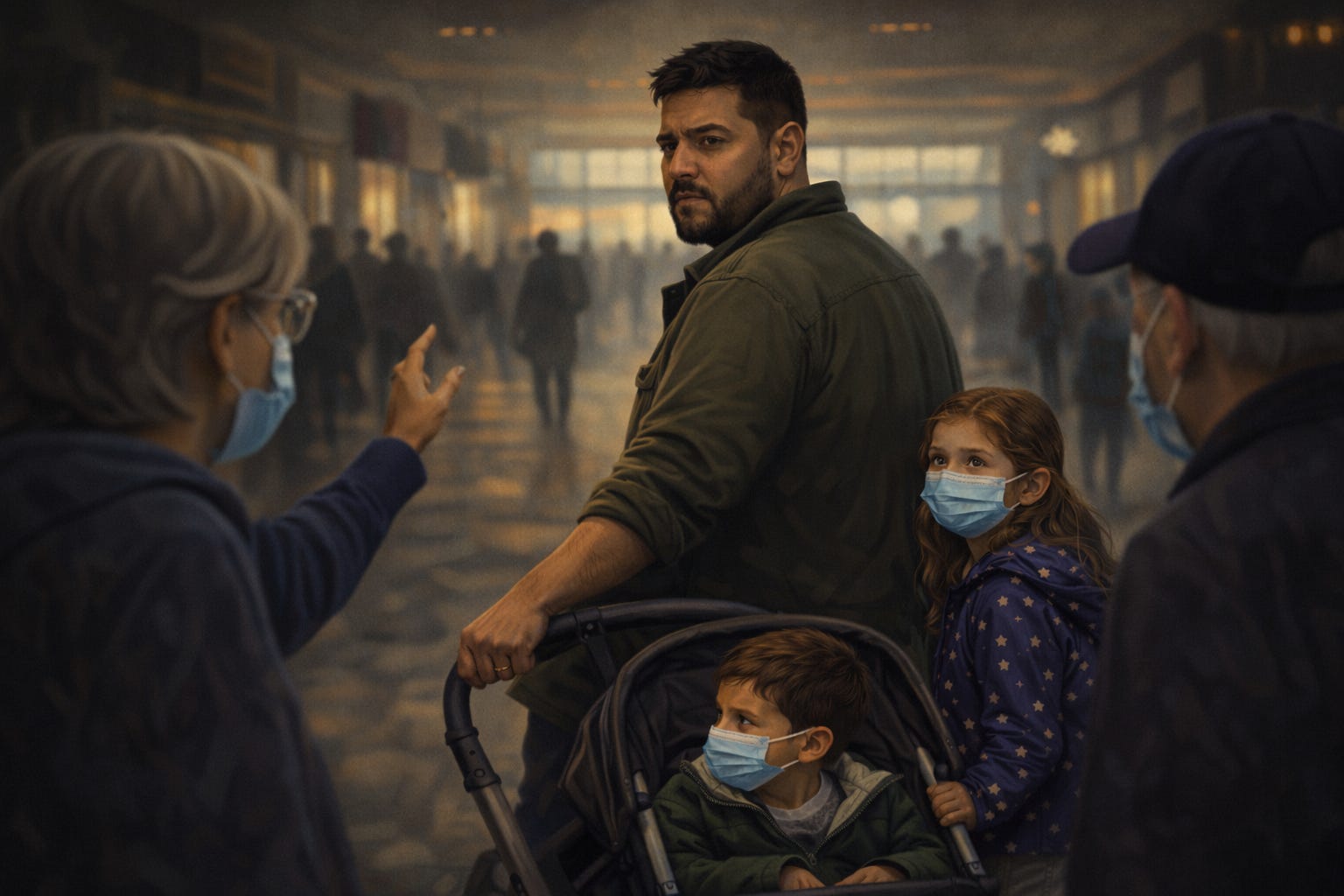
One afternoon Amir took the kids to the mall just to get them out of the house. Even that simple act now carried the flavor of minor rebellion. Clara had stayed behind, exhausted and in no mood to be around people, and Amir told himself that a short walk through open space would do Sofia good, maybe let Eli burn enough energy to sleep properly for once.
The mall was half-alive in that strange way public places had become, not empty exactly but thinned out, cautious; every movement shadowed by self-consciousness. Some stores were dark behind their grates. Others glowed too brightly. The smell of pretzels and floor cleaner still floated through the corridors, but even that old familiar mixture seems weaker now, as if the building itself were holding its breath.
Sofia walked beside him swinging her arms, her little mask slipping down every few seconds because she hated the feel of it on her face. Eli sat in the stroller, tugging at his own until one ear loop came loose entirely and left it hanging crooked against his cheek. Amir had long since learned the futility of trying to keep children perfectly arranged with norms they didn’t understand. He adjusted Sofia’s mask once, fixed Eli’s briefly, and kept moving. They had barely passed a kiosk in the middle of the corridor when a woman several yards away turned sharply toward them as if she had been waiting all day to find someone imperfect.
“Sir,” she snapped, loud enough to make people glance over, with a phone pointed at Amir. “Your kids need to have their masks on properly.”
Amir stopped walking and looked at her. He glanced around to take measure of the situation before responding, always prioritizing his children’s safety. “Are you recording me?” Amir asked, visibly irritated. “They’re kids,” Amir said. “Relax.”
“That’s not an excuse,” she shot back. “There are rules for a reason.” Amir was starting to reach a point where he may something stupid, and he recognized the lady with the phone in his face wanted him to do exactly that. “Please stop recording us. You do not have permission to record myself and my kids. Leave us alone.”
Sofia instinctively moved closer to Amir’s leg. Eli, sensing the energy more than the content, started squirming and whining from the stroller.
Amir felt the heat rise in him almost immediately. The months had done that to everyone. Patience had thinned and civility had become conditional, with every small confrontation seeming to carry the weight of all the others building beneath it.
“Why don’t you mind your business,” he said. “Get lost.”
The woman recoiled as though he had spat at her. “Excuse me?” Now she seemed visibly upset. “I’m going to make sure you go viral for not taking other people’s safety. You know this virus is deadly for the immunocompromised? Do you know that, sir?” She began to amp up, almost as if the dopamine from confronting a complete stranger made her bolder.
Before Amir could respond, another voice joined from behind, male this time, sharp and eager, the kind of tone people used when stepping into conflict as though entering a performance already in progress. “Maybe he doesn’t care,” the man said, now also pulling out his phone. “Maybe he’s privileged enough not to worry about other people.”
Amir turned and saw a younger guy, maybe early thirties, holding shopping bags in one hand, and wearing his mask like a badge of moral rank. He had that look Amir had grown to hate over the past few months, the expression of someone thrilled to be on what he believed was the correct side of history in a confrontation too small to matter.
“Privileged,” Amir repeated, almost laughing from disbelief. “You don’t know a damn thing about me.” Amir thought to himself, what the hell is going on? “I know enough,” the man said. “People like you are why this keeps spreading. You know you could get my grandmother sick, and she could die.”
“Then tell them to stay the fuck indoors! That is not my problem!” Amir was done. The man, and the woman, smiled with glee. They were getting pleasure from this, and Amir could tell, but his anger got the best of him. Sofia tugged at his legs, “daddy?” She whispered and noticeably scared.
The woman folded her arms, emboldened now that she had backup. A few others slowed their pace without fully stopping, that ugly little instinct people had to witness conflict while pretending not to. More people started pulling out their phones pointing directly at Amir and his family.
Amir looked at Sofia, then at Eli, then at the two strangers who had appointed themselves deputies of public virtue in the middle of a mall corridor. For a split second he imagined continuing it; what he thought of their fear, their arrogance, and their sudden hunger to control other people under the cover of concern. But Sofia was looking up at him with wide, uncertain eyes, and Eli had started to cry in earnest.
So Amir did the only sensible thing left. He gripped the stroller and walked away. While he walked away, mall security finally showed up to tell them that they cannot film inside the mall, because it is not a public space. That damage had already been done, and the people knew that they couldn’t record. The use of ignorance protected many from getting into conflicts.
Behind him he could still hear the woman muttering, could still hear the man saying something about selfishness, community, responsibility, the usual ceremonial language people used now when they wanted to sanctify their own aggression. Amir didn’t turn back. He pushed faster toward the exit, Sofia half-jogging beside him to keep up, the sound of the mall flattening into a distant blur around the pulse in his ears.
By the time the automatic doors opened and the outside air hit his face, he felt less like he had escaped an argument than a checkpoint. His phone vibrated. It was Clara. “Did you get toilet paper?” she asked the moment he answered.
“Hello to you too, honey.” He sounded more annoyed than he meant to, but his mood was still elevated. “I couldn’t find any,” he said. “I’ve never seen so many stores without toilet paper. I’ll steal some from work if I need to.”
No goodbye. No I love you. Those had become less common than either of them wanted to admit. In the parking lot, Sofia looked up at him and asked, “Daddy, were they mad at us?” Amir exhaled hard and rubbed a hand over his mouth. “You know, honey? I’m not sure,” he said. “We were just there.”
She thought about that in silence, then asked no more questions, which somehow made it worse. That night, after the kids were down, Amir told Clara what had happened. She listened from the kitchen table, arms folded, her face carrying the hard, unsurprised look of someone whose faith in the public had already been stripped down to the studs. “I’m telling you,” she said, “people have lost their minds.”
“It’s clout.” Amir muttered. “Didn’t even matter what. They just wanted someone to attack so they could get a viral moment.”
“Ugh, I’m so glad I don’t take any of this seriously,” Clara said.
Amir sat across from her, tired in the particular way 2020 seemed to make everyone tired, not sleepy but depleted. “It’s everywhere now,” he said. “Not just masks. The way people talk… like they’ve been deputized.”
Clara gave a humorless laugh. “Of course they have. They don’t need the government standing over every shoulder if neighbors will do it for free. These people won’t admit it, but they love having authority over people.”
A few months later the conversation turned again, this time to vaccines. By then Operation Warp Speed had become more of a political talking point and now being executed. The speed of it unsettled Amir, but to be fair, it made everyone wary. The vaccine was made fast and is something most people assume is a long process, however they were able to circumvent many regulations because it was declared a national emergency. This meant a lot of potential checks and balances for the vaccine were neglected in the name of national emergency.
Amir knew that COVID-19 was not new. SARS was essentially the same thing, but was contained fairly quickly compared to COVID-19. He knew enough from back in his wikipedia days that the coronavirus that caused SARS was similar to COVID-19, which meant research had already been done. This lore was not known to the average American, who were facing a visible IQ decline. All of it manufactured without anyone knowing.
Clara was easier to read on the subject. “I’m not giving that to the kids,” she said flatly one evening from the couch, not even looking up from her phone. “No.” Amir sat in the recliner, heavier now than he wanted to admit, his doctor’s warnings still fresh in the back of his mind. “You don’t even want to wait and see?”
“I’ve seen enough.” She retorted confidently.
“You don’t know that. I’m sure the vaccine is safe… but I won’t take the first round.”
“You are free to do what you wish,” she said, finally looking at him. “This whole thing got blown out of proportion from the start. No. I’m not doing that to them. I bet it’s just the flu anyway.”
Amir leaned back and stared at the ceiling for a moment. “I’m not saying I trust them… but I trust my doctor. She’s been my doctor for over twenty years now. She tells me to take the vaccine, but…”
“But?” Clara responded, curiously.
He hesitated. His weight had been a problem for years. He knew it. He joked about it when he could, ignored it when he couldn’t, promised himself each January that this would be the year he finally got serious. Now his doctor had put it in blunt terms: high risk.
“But I’m not exactly in a great category here,” he said quietly.
Clara’s face softened only a little. “That doesn’t mean you rush into something because they scared everybody.”
Amir would later be very grateful he did not take the first round of vaccines.
The room went still after that. On television, some anchor was talking over a panel about rollout timelines, case counts, public confidence, expert recommendations, side effects, responsibility. The words all bled together. What mattered was that the choice was now moving toward them, no longer theoretical, no longer something happening only to other people.
Amir said nothing for a while. He knew better than to argue. Months passed. He watched and listened; arguing with himself. He told people he was still thinking about it, which was true and also a way of buying time, but the fear that finally moved him was not faith in the government, or the media, or the pharmaceutical companies, and certainly not any grand language about duty. He ultimately just trusted his doctor, and that was that.
Work became its own source of pressure long before that. Life had not slowed down the way the slogans suggested it would. There was no great collective pause. Bills kept moving, because employers kept expecting. The machine adapted without becoming gentler. Eventually the warning stopped feeling theoretical enough to ignore. Between the stress, the fear of catching the virus, and the sick realization that no paycheck felt worth gambling with his health, Amir quit. He felt the best decision at the time was to quit his job, telling himself that he can’t take the risk.
He told himself it was temporary. Most people told themselves that about one thing or another in 2020. He also told himself he was still rehirable at the job he left, though even that reassurance felt thinner as time went on.
By the end of the year, Amir took the shot anyway. However, later the media would continue to push a narrative that the COVID-19 virus was constantly ‘changing strains’, and new vaccines were constantly being pushed. The entire spectacle made no sense to Amir, because it felt like the government was hiding something sinister behind it all. What made it even worse was the censorship, especially on the internet. Using ‘national security’ as an excuse to validate people’s First Amendment rights, censorship around COVID-19 was rampant. You couldn’t even speak openly on platforms like YouTube without risking flagging your channel.
As people adopted to the ‘new normal’, COVID-19 would slowly fade into obscurity as people moved on. The pandemic had served its purpose, with the most rich and powerful companies in the world now being in the hands of technocrats. It also gave them the knowledge that the public was easy to manipulate, and easy to turn on themselves. All going as according to the ‘project’.
Behind the scenes, the cabal watched in delight. They saw how quickly people lined up for the first round of vaccines. They relished how easily citizens policed one another. For them, the experiment had gone better than expected.
The virus may never have left China, Amir would sometimes think. Maybe it never spread the way they said it did. Later he would find it curious that flu deaths seemed lower than usual in 2020, while COVID-19 numbers climbed with relentless certainty. That could simply be because both viruses presented similar symptoms and because of that it wasn’t tracked properly. But Amir would begin to slowly dive into conspiracy theories; something he swore he would never do.
Curiously, COVID-19 would go on to kill half a million people in 2020. The officials giving out these numbers would later be scrutinized to the point where conspiracy theorists stopped believing officials and only themselves, which caused a lot of problems. People who never took the vaccine and were proudly vocal about it were facing an existential crisis. These people were dying… of complications from COVID-19. The echo chambers on the internet had become so dangerous, that people believe random strangers on virology to the point where they risk their own health.
All acording to plan.
‘THE TECHNATE’ Prologue | 1 | 2 | 3 | 4 | 5 |
Amir’s story follows a struggling family entering 2020 as financial strain, a deteriorating home, and emotional distance begin to weigh on his marriage, all while early news of a mysterious illness sparks his suspicion of hidden agendas; the narrative then shifts to a quiet but calculated conversation in the White House where leaders see COVID-19 not just as a crisis but as an opportunity to consolidate power, wealth, and public compliance, before returning to Amir as the pandemic transforms everyday life into a tense, divided landscape where people enforce rules on each other, fear reshapes behavior, and his family fractures over trust, vaccines, and survival, ultimately leading Amir to quit his job due to health risks and reluctantly take the vaccine, all while sensing that something larger and more controlled may be unfolding beneath the surface of what the public is told.