
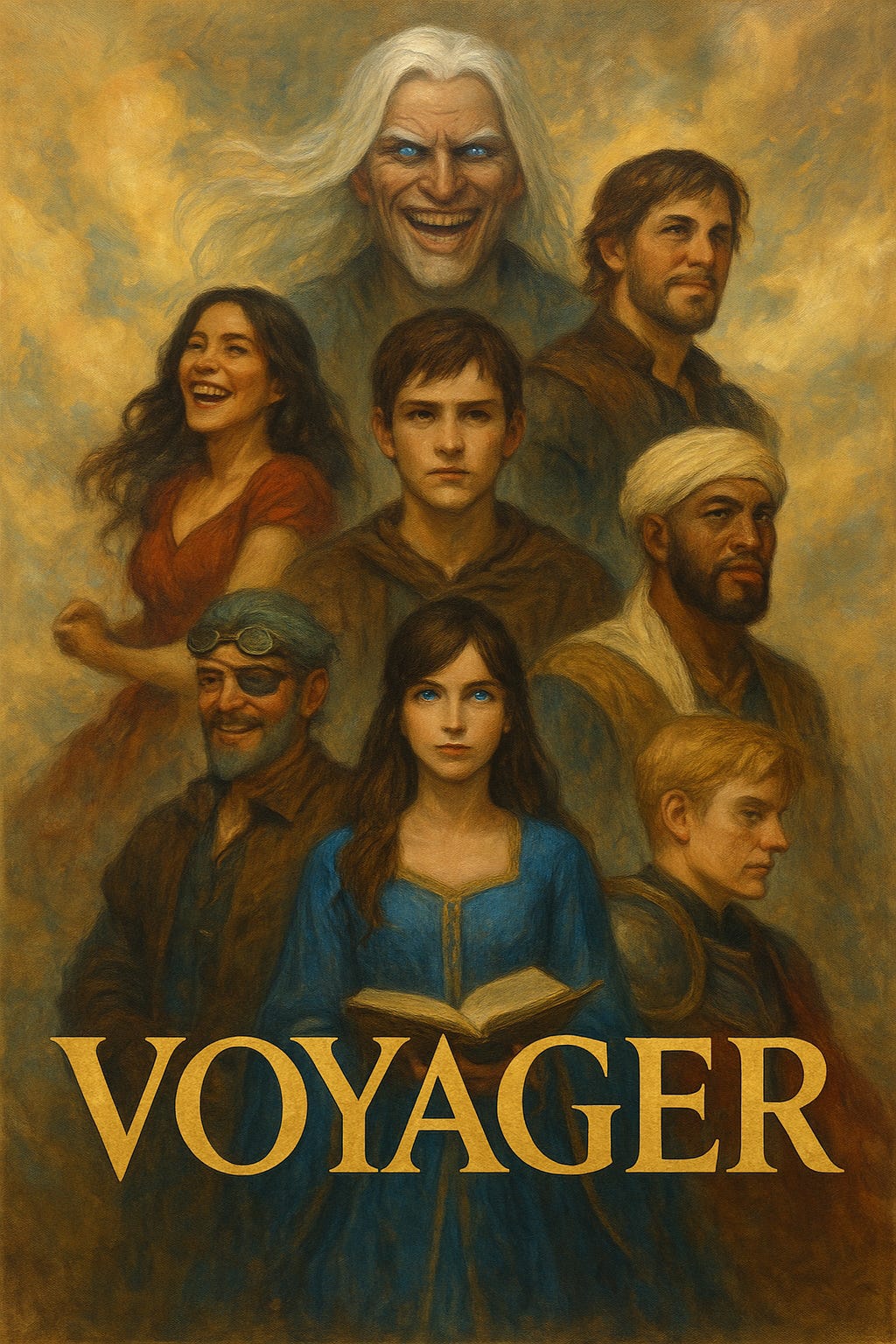
There were those who argued that a single butterfly, beating its wings in a distant and unnoticed place, might set in motion a storm on the far side of the universe. From this chaos, history would be written. A man’s decision long ago made manifest on the far side of the cosmos.
We seldom choose when fate intervenes. It doesn’t arrive announced, nor does it warn those it is about to change. More often, history enters the world softly, disguised as something small, harmless, even forgettable. From a misplaced word, or a stone kicked from a path. A choice made without anyone to bare witness. What we choose to do in the moment we seldom think twice if it brings us even a moment of pleasure. Those among us who hide in obscurity until the opportunity presents itself know well what this moment would appear to be.
Scholars would later argue whether fate existed at all, or whether the world was simply a long chain of consequences, each one pulling the next like links in an endless braid. Some would even argue against free will itself. The common folk preferred simpler explanations. They called it the will of God, a higher power that not even they could fully understand. The ancients of olde could have never imagined what they would stumble upon. Though, in the beginning, it was only a relic.
It fell without warning, long before the first kingdoms would rise from the lands of Priteria- hurling toward the earth with overwhelming force. Those who witnessed this event would later claim that a star had fallen. A streak of fire crossed the heavens, bright enough to turn night into a second dawn. It screamed as it fell, tearing through cloud and sky, and when it struck the earth, the world shuddered as if struck by a great hammer. Mountains echoed while the seas raged. A massive explosion that could be seen for hundreds of miles; animals fled and men fell to their knees, convinced the end had come at last. For the primitive natives that existed before dawn, there was no explanations. So they would create stories that would later be turned into religious doctrine for people to follow.
Once the dust settled, the Gift could be seen radiating a bright light. Not flame, but something colder and much sharper. It poured outward from the impact in silent waves, racing across the land faster than sound. Those caught in it felt no pain, only a weight, as if the world itself had pressed a finger against their souls. They rose from the calamity, seemingly unscathed, though the impact would create a thick cloud of dust that the sun would be unable to penetrate for months.
When the darkness lifted, the world was not the same. Those caught in the explosion, left in wonder as to how they are alive after being consumed by the flames. They felt the fire, the heat, and the intensity.. yet, they lived. Some who had stood in the light awoke changed. Their eyes burned blue, luminous even in shadow. They spoke of hearing whispers in the dark, of seeing shapes beneath the skin of the world. Where others saw stone and water, they saw threads. These people felt as if they were ‘chosen’ by a higher power.
They no longer called themselves ‘human’, but instead Pria. Others found the object itself, half-buried and silent, its surface smooth and unyielding, unmarred by time or tool. From it they recovered relics: a golden idol etched with symbols no one recognized, and a sacred text unlike any other, its final pages conspicuously absent.
From these fragments, humanity learned to read and to write, as well as to remember. At first, both the humans and the Pria saw themselves as one people, and peace prevailed for centuries after the Fall. They learned the same language, adopted similar cultures, and even learned to govern similarly. The similarities ended when the Pria discovered that they could use ‘magic’, twisting the aether around them into manifestations of fire, water, or other elements the wielder so chooses. Even though they could use this power, there were two types of magic that only a select few would master: Light and Dark.
The humans feared this, and those who could read would turn to the Sacred Text found from within the Gift. They would discover that the Creator forbade the use of magic. So in their fear of the unknown, and not knowing the full extent to the magic the Pria possessed, they did what humans tend to do. They went to war.
Over time, the humans came to be suspicious of the Pria. They believed that the Pria would kill all of humanity because they could not use magic, because they were different. This caused turmoil, which lead to conflict. The Pria, unmatched in strength, exiled the humans north, to Caereth and Valendia. These early humans would establish the first major settlements on these continents. Over time, Kingdoms would rise, but only three among them would survive the test of time: Sifa, Isthia, and Oredae.
Through several wars and conflicts, houses fell while those victorious continued to consolidate power. Major Houses, such as Forsyth and Habersham, would bend the knee to Isthia. Tribes that existed within the desert lands would come together under a single banner: the Sultanate of Sifia. Isthia and Sifia shared Valendia, with Isthia dominating the north and the east, and Sifia claiming dominion over the entire south of Valendia. These borders were created after generations of war.
From that power rose kings and crowns, laws and churches- wars fought not over land, but prophecy that was ordained by God himself. The Pria, marked and feared, were pushed to the margins. The Gift, once an object, became a symbol. The Old Religion that had manifested from the conflagration of this calamity was widely adopted by humans, but shunned by the Pria. Within its texts, God strictly forbade the use of magic. This gave humans a false sense that the Pria were indeed chosen, but not by God. Something else, perhaps. More sinister, evil.
Humans did as the sacred texts commanded: fear God. They created churches throughout all the human kingdoms. This hegemony would lead to kingdoms seeing themselves as one, and over time, it would secure peace. They would tell those who were deemed apostates that they would be doomed to burn in eternity, and only through the Light could there be true salvation. The Old Religion had become a way of life for humans, with the Pria remaining agnostic. This solidified the divide by humans and Pria, and the resentment of not being able to use magic would lead humanity to hate the Pria once more.
Though the Pria were stronger, they lacked the numbers, and even though they could use magic, they were no match against human steel. In the past, they held the advantage because humans were still barbaric in nature. Seeking to differentiate themselves from humans, the Pria would create a myriad of kingdoms in the southern continent of Ma’sayla, where the Gift fell. There, the Pria would stay out of human affairs, but would later begin trading with their cousins in the north. The Pria also had the advantage of being on the southern continent which was separated by the Sea of Aurador.
As time propelled forward, Pria would find a way to hide themselves amongst humans. The biggest tell that a Pria possessed was the Glow. It hovered over their eyes, giving them the ability to use aether, or so that’s the theory. The Pria learned how to hide the Glow and as time propelled forward through new dawns and old wars, they eventually assimilated with humans and even procreated. The human and the Pria co-existed peacefully within the Three Kingdoms. Those born of human and Pria would be known as ‘hybrids’, though their ability to use magic would grow weaker and weaker as future generations would be born.
This allowed some Pria to become ‘human’ again, in a way. Though much has been learned, the past has a tendency of repeating itself. In Isthia, there exists a faction made up of people who fear the extent of the power a Pria can possess. Their views are popular amongst the people of Isthia. This was mainly driven by the Old Religion, a faith that is widely practiced within the Three Kingdoms that is against the use of magic in any form. They deem magic as an affront to God, and those who use it sin against the Creator himself.
Peace exists between the Three Kingdoms, though tensions between Sifia and Isthia are higher than usual. The Sultanate claims dominion over an uncontested territory in what’s known as ‘The Cut’, but the Crown disagrees. Understandably, Sifia wants free access to sea routes, and Isthia fears that this would impose a power imbalance that favors Sifia, as Isthia gets nothing in return.
The people of both kingdoms wait anxiously, as they know that peace can be easily broken if the wrong person gives in to their pride.
Prologue from the novel, “Voyager”
The Three Kingdoms hold a fragile peace that could erupt at any moment. King Leonardo Mistral II, ruler of Isthia, has been stricken by sudden illness. Those around him prepare for the coronation of a new King- the Crown passing to the eldest, Jeshua. What would appear to be a grand occasion of continuing peace within the realm soon turns into turmoil, as Jeshua proclaims himself to be the Son of God due to his ability to wield power once thought impossible: the power of Light. He commands all Creation to come together under a single banner, to proclaim him the one true king. Most perplexing of all… Jeshua is human.