
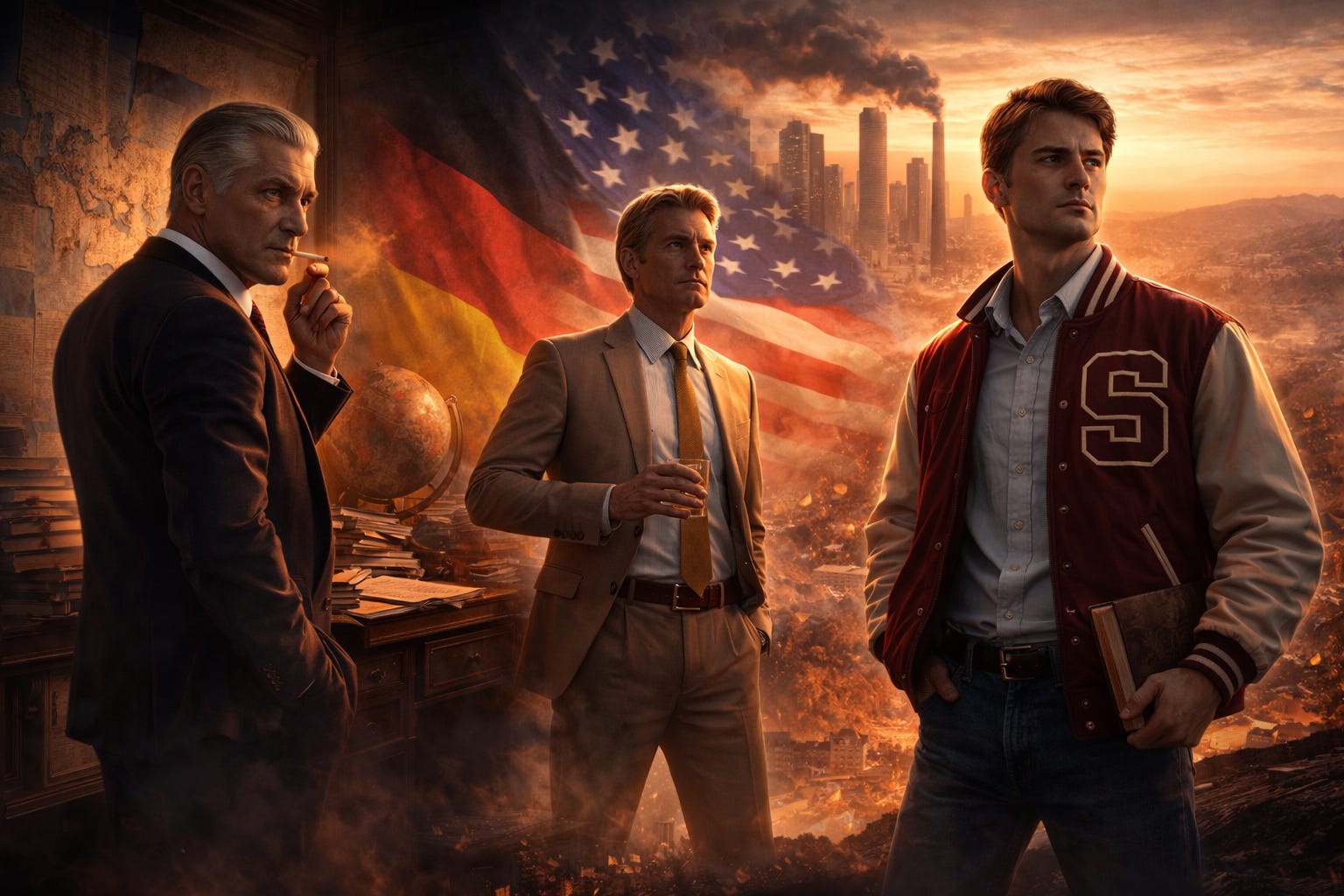
Pretoria, South Africa, July 1973
The winter light had a way of making even clean glass look tired, laying a pale film over the world as if the city itself had slept poorly and woken without conviction. Joshua stood near the window of the upper office, hands clasped behind his back, staring down at the street where men in work coats moved like currents, purposeful but anonymous. The buildings were still proud on paper, still stamped with authority and civic intention, yet the life inside them looked thinner each year, stretched and cheapened, as if the city were being hollowed out with teaspoons.
Joshua had arrived in Pretoria in July of 1973, a relic made obsolete in 1945. He was an aging German expatriate with the severe posture of a former officer, silver hair combed with obsessive precision, a narrow mustache clipped to an almost geometric sharpness, and pale, watchful eyes that never seemed to blink at the right moments. His suits were immaculate even in the South African heat, all charcoal wool, polished shoes, and old-world discipline. There was something in the way he carried himself, cold, exacting, and utterly humorless, that made people straighten up without understanding why. To strangers he presented himself as cultured, educated, and refined, a man of engineering, order, and historical perspective.
Beneath that polished exterior, however, lived the unmistakable shadow of a darker inheritance, the kind of old German whose ideas about civilization, hierarchy, and control had calcified decades earlier and never softened with age. He spoke in careful, deliberate sentences, each word weighed like metal on a scale, and though he rarely raised his voice, there was a quiet menace in his certainty, as if he believed history’s great error had been hesitation rather than brutality. Among the few people he tolerated, he was closest to Nicklaus, whom he regarded not merely as a friend but as one of the only men in Pretoria sharp enough to understand the machinery of power. Together, the two had formed the sort of friendship built less on warmth than on shared intellect, ambition, and a dangerous fascination with how nations could be bent, broken, and remade.
Nicklaus sat across from him in a leather chair whose seams had begun to crack, the kind of furniture meant to survive generations of important conversations. “Look at it,” Joshua said at last, his voice low, carrying something not quite disgust and not quite grief. “Once, a city was a promise. A place where men built toward something. Now we cultivate decay and call it progress. We build nations only to watch them collapse into squalor.”
Nicklaus did not look out the window. He watched Joshua instead, as though he were listening to testimony from a man who had mistaken conviction for wisdom.
“That word,” Nicklaus said. “Decay.”
Joshua’s mouth tightened. “Call it what you want. I call it what I see. This decline was inevitable, engineered by sentiment, indulgence, and misplaced empathy. Sooner or later, every civilization reaches the point where it must decide whether it is willing to name weakness for what it is.” He turned from the window, and the light caught his face in pieces, the hard planes, the slight tremor in his jaw when he spoke of people as though they were defects in a machine.
As he listened, Nicklaus glanced toward the door and briefly met the eyes of a woman who had come in to change the trash. He could tell she had heard enough to understand the ugliness of the conversation, and he gave her a small, awkward half-smile, the sort of reflexive apology a decent man offers when he lacks the courage to interrupt evil directly. The young African janitor had likely endured enough from European men already, and though Nicklaus often entertained Joshua’s ideas in theory, he knew exactly how vile they sounded aloud.
“We handed the steering wheel to anyone who could stumble into the driver’s seat,” Joshua continued. “We made voting a sacrament, and now we wonder why the nation swerves.”
Nicklaus folded his hands, fingers interlaced. He was less theatrical than Joshua, but there was a steady coldness in him, a preference for systems and mechanism over sentiment. “I don’t believe everyone should dictate direction,” he said. “That is not cruelty. In any nation, there are people with no stake in its future, and yet they’re given equal say in shaping it. That is a dangerous fiction.”
Joshua’s eyes sharpened, pleased at the phrasing, pleased at the permission. “Stake,” he repeated. “Yes. That’s the word. Not rights. Not feelings. Stake. Ownership. Pride. Skin in the game. A nation of citizens who believe they are responsible for preserving something worth having.” He paced once, slow and deliberate, like a man measuring a room for future use. “We have confused participation with wisdom. We have confused quantity with quality. In ancient cities, citizenship was a privilege, earned and guarded. Now it is treated like a giveaway prize, handed out with a smile and a moral sermon.”
Nicklaus’s gaze drifted to the bookshelf behind him, where reports and ledgers watched over the room like mute witnesses. “The sermon,” he said, the word carrying contempt. “It always arrives in the aftermath. A priest comes to bless the rubble.”
Joshua stopped pacing. “And yet the rubble has its uses,” he said. “Disorder is a solvent. It dissolves old loyalties. It makes people hungry for a hand on the shoulder, a voice that says, I will fix it.”
Nicklaus made a faint sound that might have been agreement, and Joshua took it as an invitation to continue.
Germany had embraced mass politics, to the disgust of many in the old guard. That was true in the West, and in the East things were worse, the nation severed, humiliated, and trapped behind the wall. To men like Joshua and many of the expatriates around him, Germany had emerged from both world wars not merely defeated, but degraded. They saw themselves as a people who had paid for history more dearly than anyone else.
“A hand on the shoulder becomes a hand on the throat,” Nicklaus said.
Joshua smiled, but there was no warmth in it. “Not if the person is grateful.”
Silence settled between them, heavy as a locked safe. Outside, a bus hissed to a stop and pulled away again, leaving behind only exhaust and the impression of movement. Joshua returned to the window, looking past the seemingly endless road as if he could see a century ahead and judge it with the same contempt.
“The problem,” he said, “is control. Humanity has always been a herd with delusions of freedom.”
Nicklaus leaned forward slightly. “Perhaps people should be allowed their delusions. Ideas like yours create opposition, and opposition becomes threat.”
“That is why you do not allow it to become a threat,” Joshua said. “War, massacre, ethnic purges, they have all failed when done crudely. The Führer was a fool, not because he lacked vision, but because he used methods too obvious to survive the judgment of history. Raise a weapon and you give your enemies a martyr’s narrative.”
Nicklaus nodded once. His eyes were bright in a way that suggested not inspiration, but appetite. “So you want a cage people thank you for. You want them to surrender their freedom smiling.”
“Exactly,” Joshua said, and his tone was almost reverent. “Absolute control without the spectacle of violence. A world where the levers are so far above the street that no one knows who pulled them. A world where compliance is not forced, but purchased. Where dissent is not silenced, only rendered irrelevant.”
Nicklaus exhaled slowly. “That is an elegant fantasy.”
“It is not fantasy,” Joshua replied. “It is the only hope. If humanity is to be saved from itself, something must be done before the capitalists consume everything in reach. We live among intellectuals whose empathy blinds them. They call every appetite a right, every weakness a virtue. This planet was not built to sustain endless indulgence.”
Nicklaus’s face hardened. “And who decides what salvation looks like?”
Joshua turned back to him, and for a moment the mask slipped. What showed underneath was not anger, nor even cruelty, but certainty so complete it left no room for humility.
“The ones who can,” he said quietly. “The ones who understand the machinery.”
Nicklaus’s mouth twitched. “Machinery. There it is. Your true religion.”
Joshua did not deny it. He moved back toward his desk, fingertips brushing the papers as though he could read them by touch. “Do you know what changed everything for me?” he asked, though he did not wait for an answer. “The atomic bomb.”
As soon as he said it, Nicklaus thought of Heinrich, who had once said something similar.
“Heinrich spoke of the bomb the same way,” Nicklaus said.
Joshua nodded. “I used to think such power belonged to myth. A story men told each other to keep the imagination obedient. Something from scripture, not from policy. Then the world watched a city bloom into fire, and suddenly the impossible became bureaucratic fact.”
Nicklaus watched him carefully, sensing the direction of the thought and disliking how quickly it accelerated. “Power like that ends arguments quickly,” he said. “It also ends cities.”
Joshua’s eyes flicked with impatience. “Cities end anyway. That is my point. We pretend morality is what preserves the world. It is not. Structure preserves the world. Control preserves the world. The bomb revealed that the ceiling of violence is higher than any of us wanted to admit, and once a ceiling is revealed, men begin building floors beneath it. They construct systems in the shadow of the unthinkable.”
“That is still a weapon, Joshua,” Nicklaus said. “You are only holding it farther away.”
Joshua’s smile returned, thin and satisfied. “Distance is everything. A man with a rifle is a tyrant you can point to. A system that governs your incentives, your labor, your appetite, your distractions, that is something else entirely.”
Nicklaus tapped the armrest once, restrained irritation surfacing. “And when the system is built wrong, it collapses.”
Joshua waved the concern away like smoke. “Reality is collapsing now. Look out there. We are already living inside collapse, dressed up as compassion.”
He leaned over the desk, his tone shifting, almost coaxing now. “Do you know why the old empires endured? Because the productive were protected, and the unproductive were managed, directed, or used. Now we have reversed the order. We have made people believe they are equal in every respect. That lie is the most effective political instrument ever invented. It flatters the masses while hollowing out the civilization that must carry them.”
Nicklaus narrowed his eyes. “I agree that not everyone should vote. But men who begin speaking in broad categories about who is fit and who is not usually end in blood.”
Joshua met his gaze without blinking. “Then do not use blood. Use a ledger. Use a switch. Use debt. Use dependency. Use appetite. Use comfort. Use vice. Give people pleasures strong enough to distract them and systems soft enough to domesticate them.”
He paused, then spoke the next words like bait cast into deep water.
“Promise them security. Promise them care. Promise them that the state will provide. Their labor is the only thing they have to offer, and even that can be absorbed into a machine.”
Nicklaus barked out a laugh, sudden and genuine. “Now you are stealing the slogans of the very people you despise.”
Joshua did not flinch. “Words are tools. I do not care who forged them.”
Nicklaus shook his head, a smile lingering, but sharper now. “And how, exactly, do you intend to seize anything without force?”
Joshua spread his hands as though the answer were obvious. “Automation.”
The word sat in the room for a moment.
“When labor can be replaced,” Joshua said, “you no longer need to bargain with the masses. You do not need to flatter them with the illusion of ownership. The factories become obedient. The farms become obedient. Distribution becomes obedient. Production becomes function. A dial.”
Nicklaus’s laughter faded into skepticism. “You sound like an architect sketching a future war already lost. And besides, technology on that scale will not exist for two hundred years. Not in our lifetimes. Not under the current bureaucrats. Perhaps not even in our grandchildren’s.”
Joshua’s eyes glittered at the resistance, energized rather than discouraged. “Two hundred years is nothing,” he said. “Civilizations rise and fall on time scales men are too impatient to respect. Most die not because they are conquered, but because the people at the center grow soft and forget what made them possible. That is the weakness of democracy. It teaches men to consume inheritance without understanding sacrifice.”
He stepped back toward the window, and now his voice took on the cadence of prophecy, dangerous precisely because it sounded so calm. “But if you build the infrastructure, if you shape the incentives, if you train populations to accept convenience as liberty, then the day will come when control is not enforced, but welcomed. Like plumbing. Like electricity.”
Nicklaus stared at him, seeing not a visionary, but a blueprint for catastrophe. “And when the people notice the cage?” he asked.
Joshua looked down at the street, where strangers passed beneath him like ants under glass. “They will not,” he said. “Not if the cage is warm. Not if the cage feeds them. Not if the cage entertains them. Not if the cage gives them a vote that changes nothing and a voice that goes nowhere. Let them vote, but control the outcomes. Let them speak, but ensure no one important has to listen.”
He turned back, and the last of the morning light carved his face into something severe. “That is the future. A nation does not die when it loses wars. It dies when it mistakes surrender for virtue and calls it inclusion.”
Nicklaus’s expression tightened, as if he could taste the poison in the logic and still found it strangely sweet. “You are describing tyranny,” he said quietly. “And with respect, we already had an emperor of that kind in the Fatherland.”
Joshua did not deny it. He only corrected him. “I am describing an operating system,” he said. “And one day, someone will press install, and the world will thank them for it.”
Nicklaus thought for a long moment, then looked up once more. “If you could build such a nation, a state that controls the means of production through automation and dependency, where would you build it? Not South Africa. Hitler failed in Europe. Where does a thing like that take root?”
Joshua looked down, and after a brief pause, he said, “America.”
Nicklaus frowned. The United States had beaten Germany, dominated the postwar world, and established itself as a global superpower. “How so?” he asked, genuinely curious now.
Joshua clasped his hands behind his back again. “Because America has already proven it can divide itself with religious intensity over race, hierarchy, and power. It fought one of the bloodiest wars in its history over white supremacy and the structure of civilization itself. Those fractures never disappeared. They only changed language.”
Nicklaus listened more carefully now.
“The South remembers humiliation,” Joshua continued. “The North mistakes legal victory for moral resolution. The old Confederacy may be dead as a state, but not as instinct. And now Vietnam has exposed something even more important: the vulnerability of the American myth. For the first time, the population at home sees war in something close to real time. It sees its own state stripped of ceremony.”
“You have thought about this a great deal,” Nicklaus said.
Joshua smiled faintly. “Media is a weapon now. That is the difference. The American state can no longer control the narrative as easily as it once did. Technology has disrupted the old gatekeepers. That matters.”
He stopped to catch his breath, then continued.
“You use capitalism against the West and hollow it out from within. Wealth is the key. Not armies. Not uniforms. Wealth. Everyone has a price, and systems can be purchased piecemeal. You corrupt the institutions meant to protect the public while calling it innovation, efficiency, modernization. Do it slowly. Quietly. Let the people believe they are choosing every stage of it. By the time they understand what has been built around them, it will already be too late.”
Nicklaus said nothing.
“America will be the battlefield,” Joshua finished. “And freedom will be the weapon used against it. One day, that nation will be taken without a single shot.”
Forest City, California, United States
October 1977
““Pierre, stop running in the house, you little savage.”
Nicklaus had moved his family to the United States for opportunity. Even now, he still thought back to the conversation he had with Joshua five years earlier. At the time, Joshua’s vision of a technocratic state had seemed like an elaborate fantasy, the fever dream of a man too bitter to stop romanticizing control. Yet the more Nicklaus observed the United States, the more those ideas ceased to feel impossible.
“Darling, tell your son to stop running and take his shoes off.”
Nicklaus laughed and pulled his wife into a brief, warm embrace. “If you cannot control the demon, what makes you think I can?”
The mood shifted the moment Pierre ran into the living room. Nicklaus’s expression changed at once.
“Pierre,” he said, stepping forward. “What happened to your eye?”
The boy looked down and then toward his mother, waiting for permission to speak. She answered for him.
“He was cornered and attacked by a group of students,” she said. “The principal did not say much beyond that those involved were suspended.”
Nicklaus exhaled heavily, then crouched slightly to examine the bruise. He asked Pierre if he was all right, though his voice carried the tension of a man already searching for something to blame.
“Who did this?” he asked. “Why?”
His anger tightened the room.
“It was those boys again, wasn’t it?” he said, his tone already hardening into prejudice.
Pierre looked up. “No, Dad. I could not understand what they were saying. I think they were speaking Spanish.”
Something dark and immediate moved across Nicklaus’s face, a reaction less like surprise than confirmation.
“Animals,” he muttered. “Everywhere you go, the same disorder follows.”
“Nicklaus,” his wife said softly, placing a hand on his shoulder. “We should not be teaching him this.”
He brushed her hand away. “Teaching him what? To see clearly?”
He was visibly shaken, not only by what had happened to Pierre, but by the deeper humiliation beneath it. He had left Pretoria because opportunity was drying up and because he felt the country was becoming more unstable by the year. America had promised order, mobility, and reward. Instead, in his mind, it had presented him with another version of the same decay.
“They hurt our son,” he said. “And no matter where we go, it is always the same. We build, and others inherit. We sacrifice, and others demand. We create the civilization, and then we are expected to apologize for defending it.”
Three years ago, Nicklaus received devastating news that Joshua had been in a plane accident. He had passed. In the years since, he had buried himself in books, reports, and models, trying to salvage from Joshua’s thinking whatever could be extracted from its ugliness and recast as theory.
He found himself returning again and again to the same idea: a state governed not by the many, but by the competent. A civilization structured by design rather than desire. The more he watched American society, the more validated he felt.
Pierre looked up to his father, as boys often do. He wanted to resemble him, and eventually surpass him. He learned about the world through Nicklaus’s language, through the categories his father supplied, through the fears his father named as truths. Though Pierre would never speak with quite the same bluntness, the architecture of his mind was already being assembled. Nicklaus had planted the seed. The world would provide the rain.
As the years passed, Pierre would be shaped into exactly the kind of man his father believed the age required, disciplined, ambitious, resentful, and convinced that history belonged to those willing to seize it. There was no way to know then just how far that ambition would carry him, or how much chaos he would one day unleash while believing he was merely fulfilling a prophecy.
In America, though, it was the decade of hangovers.
Vietnam had not stayed overseas. It came home in the eyes of men standing silent in grocery lines, in the way people flinched at uniforms, in the way the flag itself began to feel like an object claimed by competing faiths. Watergate did more than shame a president. It taught ordinary people to distrust the government in a new, instinctive way. Suspicion entered the bloodstream. You could hear it in the jokes told too loudly at parties, in the way radios were turned up and then abruptly switched off, as if listening too long might contaminate you.
Inflation came and stayed long enough to feel personal. Oil shocks made gas stations look like battlegrounds of patience and profanity, long lines of idling engines, the smell of exhaust and resentment woven together. Every day seemed to carry the faint sensation that something else was about to break.
And California, especially, was its own country within the country, both a promise and a warning at once.
A newcomer could feel two opposite sensations at once: possibility and invisibility. Possibility, because the stories almost sounded true. Work hard enough and the country might open like a door. Invisibility, because the city was large enough to swallow you whole without noticing. You could walk for blocks and feel like a shadow moving through other shadows, hearing English like a current you had not yet learned to cross. A clerk might smile at you, and you might smile back, and neither gesture would feel like belonging. It would feel like permission to remain unnoticed.
And then, inevitably, politics seeped into the American lexicon. By the 1970s, politics was no longer confined to speeches and headlines, where it could be easily ignored. It had become grocery prices, landlord language, police glances, hiring practices, and coded phrases about “the kind of people” a neighborhood wanted. It was there in the cruiser that slowed beside you because it could. Prejudice often worked by calling itself ‘pattern recognition’.
Los Angeles had long been multilingual, but in that era its growing Hispanic communities became newly visible to outsiders who had not noticed before. Mexican American neighborhoods that had existed for generations sat beside newer arrivals from elsewhere in Latin America, each group carrying its own history, its own wounds, and its own reasons for gathering close. Markets filled with familiar foods. Spanish radio drifted through open windows. Churches hosted festivals that made whole blocks smell like home. For many migrants, those enclaves were an extension from home. A bridge; a place to land before trying to cross into something larger.
But to someone like Nicklaus, it looked different.
He believed in assimilation with the zeal some men reserve for religion, not as preference, but as the only legitimate proof of loyalty. In his mind, his family had paid the necessary price. They had trimmed their accents, muted old customs, and learned the rules of the new place. They had told themselves the rules were fair because that made the sacrifice bearable.
They had assimilated.
Peter interpreted community as defiance and comfort as arrogance. He could not see the fear underneath it, nor the practical truth that people cling to what is familiar when everything else around them feels unstable. He lacked the self-awareness to recognize the hypocrisy in resenting others for preserving what his own family mourned having to surrender.
Pierre may not have been born American, but he believed, as his father had taught him, that a nation’s customs should be respected, and he interpreted respect in the narrowest possible terms: conformity.
He did not hate individuals at first, not in the way he would later tell the story. He hated what they represented in his mind: the possibility that his family’s pain had not been noble, but optional. The possibility that all the disappearing they had done might have been for nothing.
The decade fed that resentment constantly. Economic anxiety has a way of demanding faces to attach itself to. Inflation had no face, but people still wanted one. Oil shocks had no ethnicity, but resentment still searched for a language. When a country feels like it is slipping, people do not always blame the hands on the wheel. More often, they blame the passengers who arrived midway through the ride.
Some migrants arrived and felt grateful every time the sun rose in a place where the police were not kicking in their doors, where work existed, where money could be sent home, where hope could survive another week. Others arrived and felt cheated because survival required too much surrender. Pierre watched all of it and decided that tolerance without sameness was decay. He decided that a nation could not survive as patchwork. He called it principle when it was fear. He called it loyalty when it was insecurity. And slowly, almost elegantly, he evolved into the man his father had imagined.
Most people chose whichever feeling explained their life with the least discomfort.
Pierre chose the one that let him be angry and righteous at the same time.
San Mateo, California, United States, October 1985
Pierre was in university now, already one of the top students in his class. He had mastered philosophy, or at least had come to love its structure and discipline, and from that love had grown a deep fascination with politics. Over time, he became increasingly attached to the idea that government should be guided not by the masses, but by the most intelligent and capable among them. As Pierre grew older, politics began to look more and more like a circus, all spectacle and noise, while the country around him felt increasingly fractured. Racial division seemed to widen with each passing year. Neighborhoods that had once been predominantly White were becoming more mixed with Hispanics and Blacks, and many White Americans, unable or unwilling to accept the change, fled to the suburbs.
His love of philosophy eventually led him to Stanford, where he felt certain he would be accepted. Pierre believed the future belonged to him, and he intended to use both his intelligence and his talent for networking to gain influence among the kind of people he most wanted to stand beside: the elites.
Nicklaus’s ideas had become a blueprint for him. The beliefs Joshua and his father had once treated as theory now felt to Pierre like something greater, almost a calling. The idea of a one-world government no longer seemed like fantasy to him, but like an irresistible ambition.
What Pierre did not yet realize was that he was far from alone in that ambition. There were others, men shaped by the old currents of postwar Europe, men who had carried authoritarian ideas into the modern world and dressed them in new language. They would go on to amass fortunes, corrupt institutions, and bend governments to their will. Everyone, Pierre believed, had a price.
“Valedictorian? I knew you were a nerd, but that’s an accomplishment.” Pierre smiled back at his friend Tom. He was on the verge of graduating at the top of his high school class, something he had earned through countless nights of study. “Have you heard back from Stanford?” Tom asked.
“Not yet,” Pierre replied with easy confidence, “but I’m sure I’ll get in.”
College, however, was not Pierre’s only obsession. He had also become captivated by the current president. Ronald Reagan inspired him. His polish, his class, his poise, even the ease with which he commanded a room, all of it appealed to Pierre, who had already begun to imitate that same manner in subtle ways. His growing passion for politics and philosophy gave shape to beliefs that had once only existed in fragments, and thanks to his father’s influence, those beliefs had taken on a strongly conservative bent, something that might have surprised the average American who first met him.
Pierre viewed Reagan as more than a politician. He saw him as a tactician. Reagan had successfully campaigned on the idea that the government could no longer be trusted, using Vietnam as proof of institutional failure. To Pierre, that lesson mattered. The war had shown how powerful the media could be, how deeply public opinion could be shaped, redirected, and weaponized. That was what fascinated him. He believed that once news was no longer restrained by the old standards of balance and public responsibility, it could be molded by those wealthy enough to control it. To Pierre, the average person was too complacent, too uninformed, too easily manipulated to understand what was being built around them.
The erosion of those safeguards struck him as one of the most important developments of the Reagan era, even if most people barely noticed it at the time. As regulation weakened and private corporations gained greater control over news and information, Pierre saw the outline of something much larger taking shape. The wealthy elite were no longer simply preserving power through money alone. They were gaining the ability to shape reality itself by controlling the narrative. To Pierre, this was not a flaw in the system. It was the beginning of the Technate.
Chapter 2 of the Novel, ‘The Technate’
Pierre grows from a gifted student into a young ideologue, excelling in philosophy and becoming increasingly drawn to politics, elite rule, and the belief that society should be guided by the most intelligent rather than the masses. As America grows more racially divided and socially fragmented around him, he interprets that instability through the lens his father Nicklaus gave him, seeing diversity, media power, and democratic chaos as proof that ordinary people cannot be trusted to shape the future. His ambition leads him toward Stanford and toward the world of influence, where he hopes to join the elite class he admires. Inspired by Ronald Reagan’s style and by the growing power of deregulated media, Pierre begins to see narrative control as the true path to power. By the end of the section, his father’s worldview and Joshua’s long-dead vision have fused inside him, and Pierre comes to believe that the wealthy and powerful can reshape reality itself, marking the early ideological birth of the Technate.