
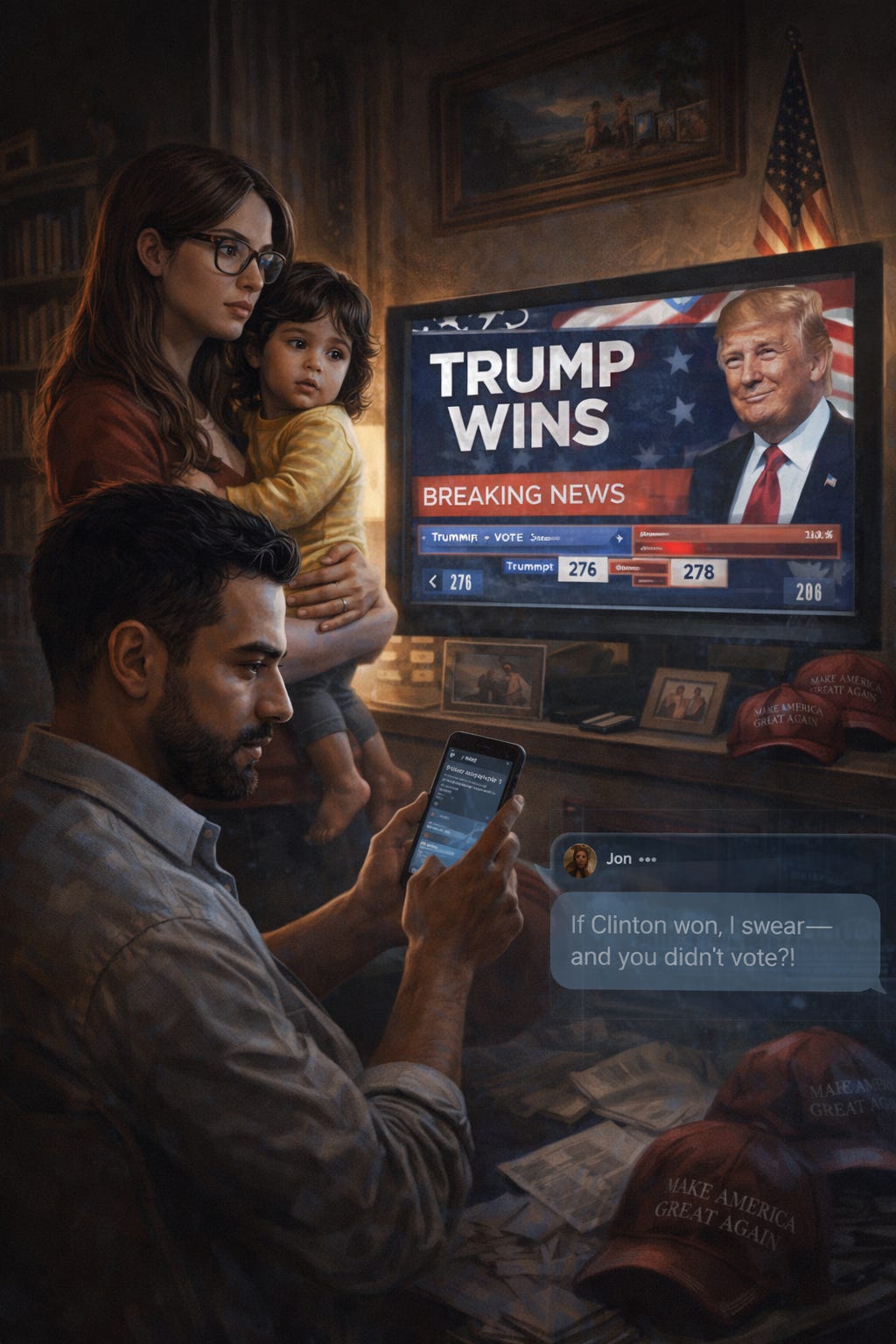
Snellville, Georgia, United States November 2016
“Hey, Clara,” Amir said, motioning her over. “Take a look at this.”
He had met Clara at work a few years earlier and had been taken with her almost immediately. She had long brown hair, green eyes, and a quiet focus that made her stand out without trying. She took her job seriously and talked often about becoming a veterinarian one day. She wore glasses instead of contacts, and for reasons Amir could never fully explain, that only made her more irresistible to him.
Clara came over with their toddler balanced on her hip. Two years earlier, they had welcomed their daughter, Sofia, into the world. Much to Clara’s mock irritation, Sofia looked more like Amir than her, or at least that was the joke he always made.
“What is it?” Clara asked, adjusting her glasses before setting Sofia down. “Go play, bug.”
Sofia wasted no time toddling toward the bookcase, her favorite activity being to yank books loose and scatter them across the floor.
“So it really does look like he’s going to win this election,” Amir said, eyes still fixed on the television.
Clara had already begun to lose interest. “You know I don’t keep up with that stuff. That’s why I have you.”
She leaned down, gave him a quick kiss, and wandered into the kitchen to make herself a snack.
Amir felt his phone buzzing in his pocket, but ignored it long enough to finish his thought. “I know you don’t, but this stuff matters,” he called after her. “One day you’re going to wish you listened to me about things like this.” The phone kept vibrating. He pulled it out and answered. “Hello, Amir speaking.”
“Hey, what’s up, man, it’s Jon.” Jon had been Amir’s friend for years, one of the few people he could still talk to without feeling like every sentence was a test. Or at least that had once been true. Politics had started to bend people in strange directions. Opinions no longer stayed opinions. They became affiliations, warnings, declarations of character. “Did you vote?” Jon asked. His tone was light, but only barely.
“Nah, man. I stopped voting a while ago.” There was a short silence. “Wait, you serious?” “Yeah, bro,” Amir said, giving a dry chuckle. “We feed our votes into electronic machines and trust systems nobody understands. Whole thing feels fake.”
Jon did not laugh. “If Clinton wins, I’mma snap. We cannot have that woman in office.” He paused, then added, “You’ve got a kid now, man. You need to care about this. Serious things are happening. Did you watch that video I sent you?” Amir rubbed at his temple. “Nah. I haven’t gotten around to it yet.”
This time the silence lasted longer. Then Jon exhaled through his nose, muttered something Amir could not quite make out, and hung up without even saying goodbye. Amir stared at the phone for a second, then sent a follow-up text that never got answered. A moment later he noticed Sofia at the bookcase, already halfway through creating another mess. He let out a tired sigh and muttered under his breath, “Why you do this, bia?” It was one of those phrases he said so often it had long since become second nature.
By 2016, the country had changed again. The tension that had been building for years was no longer subtle. It hung in the air, in conversations at work, in family gatherings, in church parking lots, in bars, in text threads that used to be about football and now turned into arguments about the end of the republic. Everything felt sharper, more brittle. People were angry, but not always in the same direction. Some looked at Washington and saw betrayal. Others looked at the media and saw manipulation. Others looked at their neighbors and saw enemies. The fracture that had opened years earlier was no longer a crack in the pavement. It was widening into a canyon.
America seemed ready to elect another populist, the kind of figure who arrived not as a cure but as a symptom. The slogan was simple enough to fit on a hat, simple enough to chant, simple enough to make people either feel seen or feel threatened. That was the genius of it. By then, the country no longer trusted institutions, but it still trusted symbols. A chant. A meme. A red cap. A screenshot. A leaked clip. A rumor repeated often enough to feel like memory.
Amir sat back on the couch and pulled out his phone, doing what he always did whenever the world felt like it was shifting under his feet. He scrolled through headlines, clips, arguments, reactions, all of it flooding past faster than any one person could make sense of. The phone unlocked with his face, a little convenience most people had already accepted without a second thought. Amir had noticed how easily people traded privacy for comfort. Once, Americans would have found that kind of thing unsettling. Now they barely noticed. The machine had learned that the surest way to place a leash around someone’s neck was to make it feel like a luxury.
The years after 9/11 had changed the country in ways most people were too exhausted to track. Surveillance had settled into daily life so gradually it no longer felt like surveillance at all. It was just policy. Just technology. Just the price of safety. There had been people who tried to warn the public, people who tore back the curtain and showed how deeply the state had burrowed into ordinary life, but their warnings dissolved into the noise like everything else. By 2016, Americans had grown used to the sensation of being watched, categorized, nudged, and sold to. They no longer asked whether the architecture around them was dangerous. They only asked whether it was convenient. They never dreamed that one day, their own government would turn their guns on them.
The internet had changed too. What had once felt chaotic and open now felt weaponized. Social media connected everyone and alienated them at the same time, turning the country into one endless room full of shouting strangers. Americans had more information at their fingertips than any generation before them, yet somehow understood one another less. Every issue became theater. Every scandal became content. Every outrage was swallowed by the next one before it had time to harden into action. Facts no longer ended arguments. They only marked which side you belonged to.
Fake news had become one of the defining poisons of the age. Some stories were obvious lies, cooked up for clicks and passed around by people too angry or too eager to care. Others were half true, which made them stronger. Some came from partisan sites, some from trolls, some from desperate nobodies on message boards, some from people who simply knew that fear traveled faster than correction. Everyone accused everyone else of being brainwashed. Every side insisted the other lived inside propaganda. Television pundits lied with polished smiles. Online activists lied with righteous conviction. Conspiracy threads sat beside real leaks, and by then most people no longer knew how to tell the difference, if they cared at all. The country had not just lost trust in institutions. It had begun losing trust in reality itself.
Clara was one of millions who did not follow politics closely. It was not because she was stupid or shallow. She was busy. Focused on the immediate facts of life. Work. Bills. Their daughter. Food in the fridge. Sleep when they could get it. Most people lived that way. Things were getting more expensive every year, and no one had time to follow politics. Most ignore the news altogether, not even giving it a second thought.
They knew something in the country was breaking, but the breakage always seemed to happen somewhere just beyond the edges of their daily routines. It was easier to shrug, easier to say all politicians were crooked, easier to tune out and carry on. The tragedy was that this was exactly what power depended on. A distracted public. An exhausted public. A public too atomized to realize it was being managed.
Amir refreshed his feed and saw three completely different versions of the country in under a minute. One post said America was on the verge of being saved. Another said democracy itself was dying. Another said the whole election was theater and both sides were puppets. Under each one were hundreds of comments from people who sounded equally certain. Nobody was persuading anyone. Nobody even seemed interested in trying. They were performing belief, signaling loyalty, sharpening themselves against one another in public.
Even truth had begun to feel partisan. Even when something was obvious, even when it could be proven, people resisted it if it threatened the story they preferred. Being wrong had become intolerable. Accountability had become humiliation. And humiliation, Amir was beginning to understand, was one of the strongest political forces in America now. People would believe almost anything if the alternative meant admitting they had been fooled.
He saw it everywhere. In the smugness of pundits who treated the country like a game board. In the casual corruption that no longer bothered hiding itself. In the confidence of a political class that had stopped fearing the public because it knew the public had been split into camps too busy hating one another to look up. Politicians enriched themselves in broad daylight. Corporations mouthed values they did not live by. Media figures sold panic as analysis. Every institution sounded hollower than the one before it.
And still, there was something else moving beneath all of it, something darker and harder to define. A growing sense that the masks were slipping. That people who once hid their appetites behind polished language no longer felt the need to bother. What had once been whispered now crept into the open, not fully revealed, but visible enough to unsettle anyone still paying attention. Amir felt it more than he could explain it. The country was losing its ability to recognize itself.
The next morning, the office felt wrong before Amir even made it through the front doors.
It was not louder than usual. If anything, it was quieter. But it was the kind of quiet that had weight to it, the kind that made every greeting sound rehearsed and every pause feel longer than it should have. The lobby televisions were tuned to morning coverage, panels of polished people still dissecting the election as if it had happened in a lab instead of inside millions of homes and families.
Red and blue maps glowed across the screens like weather patterns from some incoming storm. Amir adjusted the badge clipped to his belt and walked past the front desk with a cup of burnt coffee in one hand and his laptop bag hanging from his shoulder, already sensing that whatever normal had existed before yesterday was not coming back.
He supervised a team at one of the largest tech companies in the country, the kind of place that liked to describe itself as forward-thinking, inclusive, agile, and mission-driven, all those sterile little words corporations used when they wanted to sound human. The building was glass and steel, all polished surfaces and controlled temperatures, with motivational slogans printed on walls in soft colors chosen by consultants who probably charged more in a week than some of the contract workers downstairs made in a month.
Usually the office carried the same energy every weekday morning, the low hum of keyboards, half-finished coffees, engineers drifting between desks, product managers speaking in acronyms, people pretending to care about sprint velocity and deliverables while quietly counting down to lunch.
The place had been hiring aggressively for years, expanding, overstaffing, bloating itself under the language of growth and innovation. Some days there was barely enough meaningful work to justify the headcount. People lingered by espresso machines, wandered between standing desks, played office games, sat through meetings that existed mostly to prove someone somewhere was still necessary. It was the kind of prosperity that looked futuristic from the outside and vaguely fraudulent from within.
But today the rhythm was off. It was there in the faces first. Some looked bright, almost glowing, as if the country had just been pulled back from the edge. Others looked hollowed out, stunned, like they had slept badly and woken up in the wrong version of America. A few moved through the office with a kind of private satisfaction they were trying and failing to hide. Near the break area, a young woman whispered to no one in particular, “Is this a nightmare? Is this real life?”
Amir made it halfway to his section before he saw the hat.
It was not even the full performance, just a red cap worn low by one of the older guys from data operations, someone who usually dressed like every other tech employee in the building, quarter-zip, jeans, expensive sneakers. The hat might as well have been a flare gun. No slogan visible from where Amir stood, but it did not need one. Everyone knew what it meant. People were pretending not to notice it in the same exaggerated way people pretended not to stare at a car accident.
The same woman near the break area looked at it, looked away, then whispered something to the man beside her. He smirked without smiling. Another employee passed by and muttered, just loud enough to be heard, “Real classy.” The guy in the cap heard him, paused near the coffee machine, and for a second it looked like the entire floor might stop breathing. Then nothing happened. That was the strange part. It was never just about what people said. It was about what they were now willing to imply.
By the time Amir reached his desk, an unread company-wide email was waiting for him. The subject line was exactly what he expected: Moving Forward Together. He clicked it open and scanned the message, already knowing its tone before he reached the second sentence. It spoke of shared values, respect in the workplace, emotional sensitivity during moments of national change, and the importance of preserving inclusive dialogue. There was language about psychological safety. A reminder about reporting inappropriate conduct. A note from executive leadership reaffirming the company’s commitment to diversity, dignity, and belonging.
It was professionally written, carefully balanced, and completely bloodless. Amir could almost see the committee that had drafted it, sanding down every edge until it said nothing real at all. Around him, other employees were reading the same email, and the effect it had on the room was not calming. It only made people more careful, which somehow made everything more tense. By nine-thirty, almost nobody was working.
They were at their desks, yes. Screens were open. Slack messages blinked. Code windows sat half-filled. But the office had become a stage where people performed productivity while actually tracking one another’s reactions. Clusters formed and dissolved around standing desks and kitchen counters. Someone in marketing was openly crying in one of the glass conference rooms while two coworkers tried to comfort her. A man from legal, someone Amir had always found unnervingly polished, walked through the floor with a grin so slight it almost qualified as plausible deniability.
One of the engineers on Amir’s team, a woman who normally spoke with machine-like efficiency, was suddenly talking too much, ranting in a low rapid stream about fascism, misogyny, and the death of democracy. Across from her, another employee sat completely still, saying nothing, staring at his monitor with the kind of rigid posture that suggested silence was the only thing keeping him employable.
Amir tried to settle into his own work, but every few minutes something else pulled his attention sideways. A Slack thread in one internal channel had already been locked by HR after it turned into a brawl disguised as civic concern. Memes had started appearing in private chats before breakfast. Screenshots from Twitter, Facebook, and Reddit were being traded around like contraband. One side was passing around compilations of campus meltdowns and post-election tears, laughing at them like victory trophies. The other was sharing think pieces, warning threads, and alarmed op-eds about authoritarianism, racism, and democratic collapse. Everyone was certain. Nobody was persuading anyone. The whole office felt like a live wire wrapped in ergonomic furniture.
A project manager he barely knew stopped by his desk, to talk in a voice too casual to be casual, “Crazy night, huh?” That was how it started now. With bait. Amir gave the kind of non-answer he had perfected years ago, enough to keep the moment moving without telling anyone anything useful. “Yeah,” he said, eyes on his screen. “People are definitely feeling it.” The project manager laughed once through his nose. “That’s one way to put it.”
A little after ten, Amir was called into a leadership huddle with the other supervisors and managers on his floor. They gathered in a conference room with transparent walls, which felt appropriate in the worst possible way. Nobody said what they actually meant at first. They talked about maintaining morale, minimizing disruption, and making sure no one escalated tensions. One director, a woman with perfect posture and a voice like polished glass, reminded everyone that employees needed space to process. Another emphasized that political expression was not forbidden, but anything that made others feel unsafe would be addressed swiftly.
Amir sat there listening, half in the room and half outside of it, struck by how artificial it all sounded. The country was tearing along exposed seams, and here they were discussing it in HR-approved phrases, like the right sequence of words might keep history from entering the building. He looked around the glass box at the other supervisors pretending to nod at language nobody believed in. What the company wanted was not harmony. It wanted continuity. Productivity. No lawsuits. No headlines. No internal uprising that might disrupt the fiction that a firm built on scale, data, and growth was somehow above the ugliness of the culture feeding it.
On the way back to his section, he passed two men by the vending machines arguing in whispers that were not nearly as discreet as they thought. One was saying the media had spent years humiliating people and now everyone was shocked they had finally snapped back. The other was saying people had just voted hate into office and would spend the next few years pretending not to know that. Neither one looked at the other by the end of it. They just drifted apart, each carrying the absolute certainty of the wounded.
That was what Amir noticed most as the day dragged on: certainty. The kind that sealed people off. The kind that made them louder, harder, meaner. The election had not created that quality, but it had licensed it. It had given people permission to stop pretending they might be wrong. In office kitchens, in Slack channels, in meeting rooms, in text chains with family members, across dinner tables and church pews and bars and living rooms, millions of Americans had woken up feeling either vindicated or betrayed, and both emotions had a way of making people unbearable.
By lunch, the office was split into invisible camps. People chose tables with more care than usual. Conversations died when certain coworkers approached. Jokes came with hidden blades. Even those trying hardest to stay above it all wore the strained expression of people walking barefoot across broken glass. Amir sat with his food in front of him and barely tasted any of it. A television mounted in the corner played more post-election coverage while a closed-caption banner crawled along the bottom of the screen. Around him, employees refreshed feeds, watched clips, repeated rumors, fact-checked only what offended them, and waited for the next thing to be angry about. A company built on connection, scale, and information was full of people who no longer seemed capable of speaking to one another without first sorting each other into moral categories.
And sitting there with a plastic fork in his hand, listening to the dry hiss of the soda machine and the low static of political coverage bleeding from the TV, Amir understood something that unsettled him more than the election itself. The vote had done more than put a man in office. It had given people permission to become louder versions of whatever they already were. The smug had become more smug. The bitter had become bolder. The afraid had become crueler. The disillusioned had become theatrical. And the people who still believed institutions would somehow hold everything together sounded like children insisting a cracked dam was fine because the concrete was technically still standing.
When Amir finally got back to his desk, he found one email from an employee asking to go home early because she did not feel emotionally safe staying in the office. Two minutes later, another message arrived from someone else complaining that political hostility toward “half the country” was becoming openly tolerated. He stared at both messages one after the other, feeling the shape of the problem harden in front of him.
Everyone believed they were under siege. Everyone believed their fear was the legitimate one. And somewhere above all of them, behind the polished branding and smiling executive memos and frictionless software, the company would keep doing what all institutions did best. Adapt. Absorb. Continue making money.
Later in the afternoon, when the real work had all but died, he noticed the man in the red hat arguing with one of the women from product. The man kept grinning, shaking his head, laughing in that way people laugh when they know they are getting under someone’s skin. The woman looked like she was trying not to come apart in public.
“He’s taking away my rights and you walk in here with that hat?” she snapped. “Why would you support a fascist?” The whole floor seemed to angle itself toward them without admitting it was watching. A few people stood, hands half raised, ready to step in if the thing crossed some final invisible line. The man only laughed harder. “You people are insane,” he said. “Absolutely deranged.”
She hurled a few more insults at him, voice rising, face flushed, until someone from management finally moved between them and told both of them to take it elsewhere. The day dragged on from there, each minute feeling twice as long as it should have. Then, sometime close to five, Amir heard the elevator doors open and saw two people from HR walking toward the man in the red hat with a security officer beside them.
The man’s face changed immediately. Shock first. Then disbelief. He stood up slowly as they spoke to him in low voices. Around the office, heads lifted in sequence, one after another, until it seemed the whole floor understood what was happening at the same time. This was a termination.
He had worked there for years. He was older than most of the people around him, respected for his experience, dependable, a lifer in the way few people in tech ever were. The argument had not started with him. He had not shouted first. He had not looked close to tears. He had worn a hat, smirked through an argument, and become the one escorted out. When they led him away, the office erupted in cheers.
That was the part that unsettled Amir most. Not the firing itself, though that was bad enough. It was the cheering. The way people who had worked beside this man for years, who had chatted with him in hallways and trusted him with projects and eaten lunch three tables over from him, now celebrated his removal as if some moral contamination had been scrubbed from the building. The woman who had screamed at him kept her job. He did not.
Amir watched the applause ripple out and die down, leaving behind an office full of people pretending they had not just enjoyed it. Something about that moment lodged itself deep inside him. Before the election, these people had mostly gotten along. Or at least they had pretended well enough. Now disagreement itself was becoming a stain. A scarlet letter. A sign that one side of the ideological divide could be treated not just as wrong, but as unclean.
He looked across the floor at rows of expensive monitors, ergonomic chairs, glowing logos, and people too educated to sound this primitive. For all the talk of progress, for all the data and code and innovation and ambition, it still only took a single election to drag the tribal animal back out into the light.
Virgin Islands, United States 2016
Giselle had a graceful way of moving through a room, the kind of elegance that made people underestimate her until it was too late. Jeff had noticed that about her almost immediately when they first met years earlier. She carried herself with poise, spoke with precision, and understood something most people never did: power rarely needed to shout when it was already being obeyed. Over time she had become one of his most trusted associates, though neither of them would have used a word so dramatic out loud. In private, they spoke plainly. There was no need for theater between them. They understood each other too well for that.
They had spent years watching the public stumble exactly where it had been nudged, and there was a private satisfaction in seeing how easily entire populations could be turned against themselves with the right mixture of vanity, grievance, humiliation, and fear.
Giselle had played an important role in shaping the next phase of that fracture online. Jeff’s earlier outreach to Chris had only been the opening salvo. The goal had never been chaos for its own sake. What they wanted was something cleaner than that, something self-sustaining. A digital environment where every disagreement hardened into identity, where politics became less about persuasion and more about belonging, where truth mattered only when it was useful and compromise became indistinguishable from betrayal.
If the conditions were right, people would do the rest themselves. They would radicalize one another. They would build tribes, defend slogans, and wage endless little wars for attention and moral superiority, all while believing they had arrived at their opinions independently. The beauty of it, Jeff often thought, was that no one needed to be instructed directly. They only needed a stage and the right lighting. “How did you manage it?” Jeff asked, watching her cross the room toward the window. “Becoming one of their moderators was a clever move.”
Giselle turned back toward him with the faintest smile, amused that he was asking a question to which he already knew the answer. “Charm,” she said simply. Jeff let out a quiet laugh. “Of course.”
It had been charm, but not the harmless kind. Giselle knew how to mirror people back to themselves. She knew how to flatter resentments without appearing crude, how to present herself as reasonable while quietly shifting the temperature of an entire conversation. On the forums she had become indispensable by doing what the best infiltrators always did. She did not lead with ideology. She led with tone. She made people feel understood. She validated their frustrations, encouraged their suspicions, rewarded their aggression selectively, and helped create the impression that the most extreme voices were also the most authentic.
Over time, the center of gravity shifted. Moderation began to look weak. Nuance began to look compromised. Every side became convinced it was under siege, and once people felt besieged, they became remarkably easy to guide. “All that noise online,” Jeff stated, “and still people think they’re choosing it for themselves.”
“They prefer it that way,” Giselle replied. “People want to feel manipulated by no one. It preserves their dignity.” Jeff smiled faintly. “Dignity is easy to preserve when someone else is doing your thinking for you.” She moved to the bar cart in the corner and poured herself a drink. The room around them was quiet in the expensive way only the wealthy could afford, insulated from the world by distance, secrecy, and design. Beyond the windows, the water lay still and blue, the kind of view that made power feel natural.
“The election accelerated things,” Giselle said. “Not just the right. The left too. Everyone is more performative now. More theatrical. They don’t argue to persuade. They argue to be witnessed.” Jeff nodded. “That was always coming.”
“They don’t trust the media, the government, the universities, the churches, the corporations, even their own families. Every institution is suspect now.”
“Good.”
Giselle glanced at him. “You say that like collapse is tidy.” “It doesn’t have to be tidy,” Jeff said. “rather… nothing about this will be tidy.” She took a sip of her drink, studying him. “The president is still a variable.”
“He’s theatrical,” Jeff said. “That’s not the same thing.” “He still has instincts. Instincts create problems.”
Jeff shook his head. “No. He’ll fold when it matters. They always do. The office consumes them. The pressure, the access, the flattery, the fear. He may posture. He may rant. He may even convince himself he’s independent. But when the moment comes, he’ll fold.” “And if he doesn’t?”
Jeff’s expression tightened, not dramatically, just enough to cool the room another degree. “Then pressure will be applied elsewhere.”
Giselle knew better than to ask him to say more plainly what he meant. Some things did not need language between them. She knew enough already. Enough about the private dinners, the discreet favors, the leverage men built through appetites they considered secret until someone wealthier cataloged them. Enough about the island, the girls, the visitors, the kind of compromise that made powerful men obedient long after the moment itself had passed.
“The firms are ready,” Jeff said after a while. “Most of them were easier than expected. Once they understood where the currents were moving, they stopped resisting. No one wants to be left outside the architecture of what comes next.”
“And they all agreed?”
“They agreed to what was necessary. Some because they believe in it. Some because they fear it. Some because they think they’ll control it. The reasons don’t matter.”
That was what separated Jeff from zealots. He had no need for banners or manifestos. He did not crave public worship, and he did not confuse visibility with power. He preferred the shadows, where influence was quieter and therefore more durable. He moved through private dinners, foundations, consultancies, think tanks, shell companies, intelligence briefings, and back-channel meetings with the ease of a man who belonged everywhere and nowhere at once. He knew financiers, founders, politicians, media brokers, executives who spoke earnestly about ethics while building systems they would never subject their own children to, and philanthropists whose public benevolence existed mainly to conceal what they required in private. They were the real aristocracy of the age, not bound by nation so much as by class, a disciplined fraternity of people wealthy enough to treat the future as a private investment opportunity.
“The forums are maturing faster than we expected,” Giselle said. “The left keeps getting more performative. The right keeps getting more reactive. They feed each other now without much help.”
“Good.”
“And the younger ones are the easiest. They don’t want to understand anything. They want belonging. They want enemies. They want to be seen.”
Jeff turned from the window. “Alienation is the most valuable resource of the century. Give people enough loneliness, enough humiliation, enough noise, and they will cling to whatever identity promises relief. Feed them enough dopamine that they’ll stay sedated. Give them enough information and they drown. Give them enough performance and they mistake it for conviction. Give them enough fear and they begin policing one another for you.”
Giselle gave him a measured look. “You make it sound inevitable.”
“It is inevitable,” Jeff replied. “The only question is who shapes it first? The goyim will just go along with it without realizing they could have stop this.”
For a moment, the room fell quiet. Below them, the world remained blissfully unaware. Screens glowed in apartments. Cars moved through intersections. Office towers stood full of people answering emails and attending meetings and arguing online, still imagining history would arrive in obvious forms, dramatic and easy to recognize. Neither Jeff nor Giselle shared that illusion.
They knew history was usually administrative. It arrived in updates, incentives, terms of service, cultural campaigns, curated outrage, and the steady erosion of trust. It arrived smiling. It arrived optimized. And by the time ordinary people realized they were inside it, they had usually already helped build the cage themselves.
Jeff adjusted the cuff of his sleeve and glanced at Giselle with quiet satisfaction. “Keep the pressure where it matters. Reward outrage. Smother sincerity. Push every disagreement toward identity. Once people can no longer imagine each other as neighbors, the rest becomes logistics.” Giselle nodded once.
No dramatics. No oath. None was needed.
The work was already underway.