
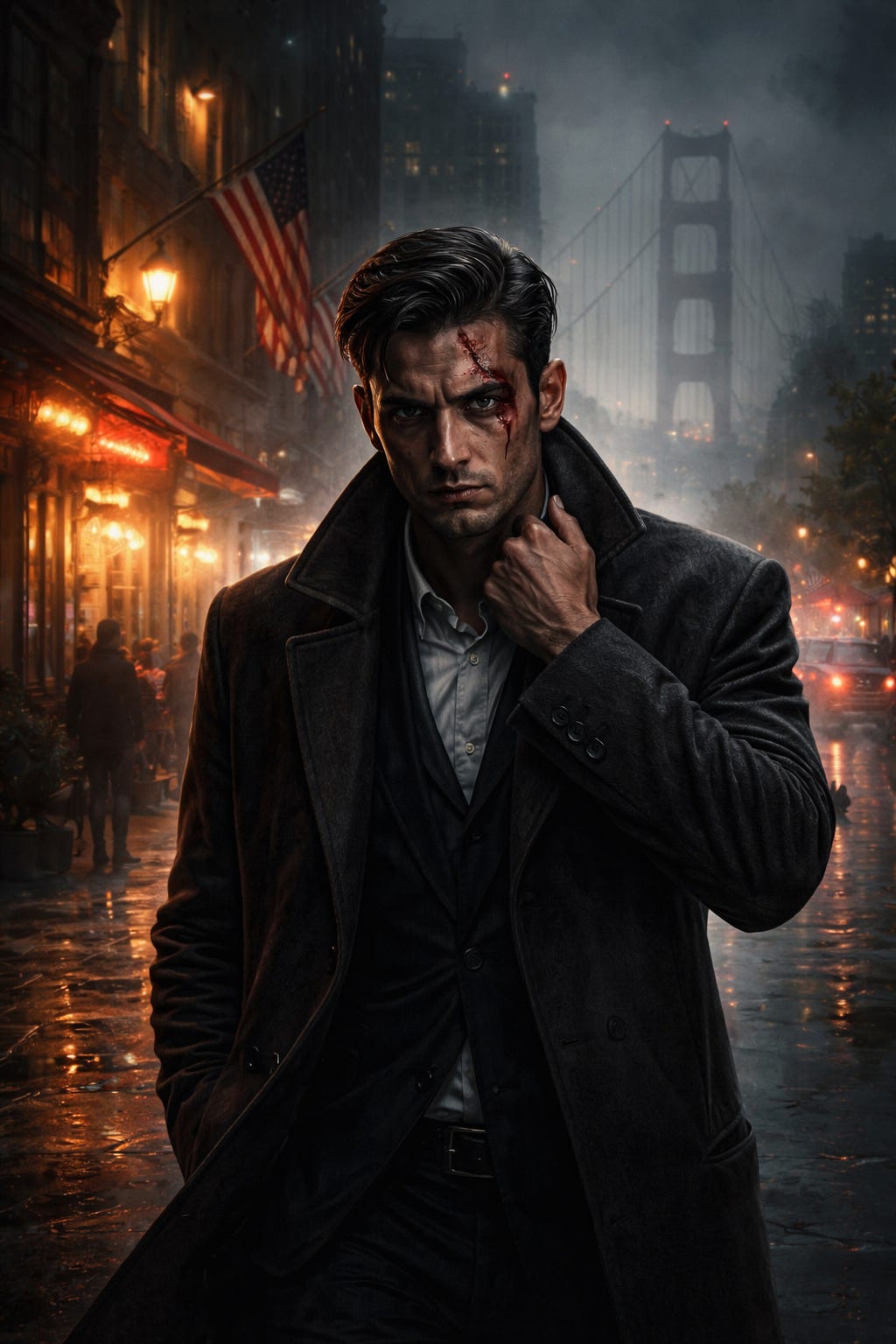
San Francisco, United States 2004
Pierre’s apartment in San Francisco was clean in the way a place became when the person living in it treated disorder like a moral failure. The plates were simple white porcelain, the table dark walnut, the light above them a low amber glow that softened the city leaking through the windows. Beyond the glass, San Francisco glittered in fragments, wet streets reflecting neon and headlights like spilled circuitry. Inside, there was only the quiet clink of silverware and the hum of a world still small enough to believe the internet was mostly harmless. Pierre sat at the head of the table in a pressed charcoal button-down, sleeves rolled neatly to his forearms, his posture upright even in private.
Across from him sat Luke, similarly dressed, his tie loosened, his expression calmer, easier, as though he carried none of the tension Pierre wore like a second skin. They had finished most of their dinner by the time the conversation turned where it always seemed to turn with Pierre, toward systems, influence, and the architecture of power.
Luke set his fork down first. “You keep talking about this kid like he’s some sort of genius,” he said, studying Pierre over the rim of his glass. “That usually means you’re already interested.”
Pierre gave a thin smile. “Interested isn’t the word I’d use.”
“No?” Luke asked. “Because for a man who claims he isn’t impressed, you’ve mentioned Facebook three times this week.”
Pierre leaned back slightly, folding one arm over the other. “It’s not the site itself that interests me. College students posting photographs, building little social clubs online, measuring themselves against one another in public. It looks frivolous. The scope is limited. A smarter man would have allowed everyone to join from the start.”
Luke raised an eyebrow. “I’m sure that could be done with some convincing, and you may be able to change that if you become an outside investor.”
Pierre’s smile deepened by half an inch. “I was thinking about that.” He gave Luke a faint smile. “It’s at least worth a meeting.”
Luke nodded once, as if Pierre had finally said the thing he’d been waiting to hear. “Exactly. Which is why you should meet him and get the ball rolling on the investment.”
Pierre tapped a finger once against the side of his glass. “You think I should put money into a digital yearbook.”
“I think,” Luke said, “that you should stop pretending you only see it for what it is today. You always talk about trajectories. So follow the trajectory.”
Pierre glanced toward the window, toward the city, but he was not looking at San Francisco anymore. He was looking somewhere beyond it, somewhere abstract, where nations were not people so much as behavior patterns waiting to be arranged.
“The power of information is understated,” he said quietly. “That’s what most of them don’t understand. They imagine information is a byproduct instead of recognizing it as a foundation. Every empire in history was built on knowing something before someone else did. Trade routes. Grain reserves. Political loyalties. Military positions. The names change, the mechanisms change, but the principle doesn’t. Men don’t change.”
Luke let him go on. He knew Pierre well enough to understand that interruption only made him retreat deeper into abstraction.
“When I founded Argus last year,” Pierre continued, “I didn’t do it to build another software company. I did it because I’m tired of institutions making decisions in darkness and calling it leadership. Governments are blind. Corporations are blind. Even intelligence agencies are blind half the time, buried under so much paper and noise that they can’t distinguish a pattern from static. Argus exists for one reason only. To gather information, to organize it, to make it usable.” He paused, then looked back at Luke. “That is power. Not money by itself. Not force by itself. The ability to know.”
“It doesn’t matter how much information you have,” Luke interjected. “Force always wins. You can be an expert on a subject, but if the person you’re fighting has a gun and you have a book, you lose.”
He sat back in his chair, watching Pierre with that familiar look that was part affection, part calculation. “But Facebook isn’t a distraction from Argus,” he said. “It could become part of something much bigger. The two could work in tandem.”
Pierre said nothing.
Luke pressed on. “You’re thinking in terms of governments, intelligence, institutions. Fine. But social media changes the scale. People volunteer everything. Their names, friendships, preferences, habits, photographs, politics, grudges, insecurities. They map themselves. Publicly. Constantly. Not because they’re forced to, but because they want to be seen. That’s the part you’re underestimating. They’ll do the work themselves.”
Pierre’s eyes narrowed slightly, not with disagreement but concentration. Luke could always tell the difference.
“Most technologies fail because they ask too much of people,” Pierre said.
“And this one asks almost nothing,” Luke replied. “Join. Add your friends. Post your life. Compare yourself to everyone else. It’s frictionless. That’s why it matters.”
A silence settled between them, though not an uncomfortable one. Pierre picked up his fork again, more out of habit than appetite, then set it down untouched. Somewhere below, a siren moved through the city and faded. In another room, a clock ticked with a precision that seemed made for him.
“What’s the founder’s name again?” Pierre asked.
“Scott,” Luke said. “Harvard kid. Young. Sharp. Probably more ambitious than he knows.”
Pierre gave a short, humorless laugh. “That usually means dangerous.”
Luke smiled. “From your mouth, that’s a compliment.”
Pierre tilted his head, conceding the point. “Maybe it is.”
Luke leaned forward now, elbows resting lightly against the table. “You keep saying your project requires scale. You keep saying the future belongs to whoever can see society as it is, not as it pretends to be. Well, here it is. A live feed of human behavior. Voluntary dossiers. Relationship graphs. Preference maps. Status signals. If Argus is about collecting and interpreting information, this gives you access to a culture training itself to confess.”
Pierre’s expression changed. The word confess hung in the room for a beat. It was exactly the sort of language that appealed to Pierre, something halfway between philosophy and strategy.
He stood from the table and walked toward the window, one hand resting in his pocket. The city below looked bright and open, but Pierre saw cities the way generals saw terrain. Every glowing apartment suggested a person. Every person suggested a network. Every network suggested leverage. He had built Argus because he believed the modern world was too quick to ignore patterns. Facebook, until now, had seemed like an amusing little campus phenomenon, one more novelty in an age inventing them by the week. But Luke had done what very few people could do. He had reframed it in a way Pierre could not dismiss.
“It would begin with students,” Pierre said at last, still facing the glass. “Elite campuses first. They’ll believe it belongs to them. That exclusivity will make it desirable. Then it spreads outward. Other schools. Then professionals. Then everyone. Once the habit forms, the platform changes from novelty into infrastructure.”
Luke remained seated, but there was satisfaction in the stillness of him. “That’s what I’m saying.”
Pierre turned back. “No. That’s not what you’re saying. That’s what I’m saying now because you were right.”
Luke smiled, small and private. “I’ll take the victory however it comes.”
Pierre returned to the table, but he did not sit right away. He placed both hands against the back of his chair and looked down at the half-finished meal as if the answer had been sitting there between the plates all along. “Argus was founded to make information legible,” he said. “To gather what others overlook and transform it into foresight. I built it with governments in mind because states understand fear better than anyone. They always pay to see threats before they arrive. But culture may prove even more valuable than threat detection. Culture tells you where the threats will come from before the state itself can name them.”
Luke looked up at him. “So.”
Pierre finally sat. “So I’ll invest.”
Luke nodded once, as though confirming a prediction instead of celebrating a win.
Pierre continued, more to himself now than to Luke. “Not because of what Facebook is. Because of what it will teach people to surrender. They’ll call it connection. Community. Expression. They’ll think they’re building a social tool when they’re really building an archive of human desire.”
He reached for his glass and took a measured sip. “And archives,” he said, “are where power learns to read the future.”
Luke said nothing after that. The decision had been made, and once Pierre made a decision it ceased to be a conversation and became the first sentence of history. Outside, the city kept glowing, innocent in the way cities always were when they stood on the edge of something they could not yet name. Inside the apartment, under warm light and the quiet remains of dinner, Pierre had just placed his hand on a thread that would one day run through billions of lives.
In 2004 it still looked small enough to hold between two fingers. That was the nature of such things. The engines had ignited. Now it was only a question of who would be allowed to steer.
Pierre left the apartment just after dusk, when San Francisco was entering that brief hour where the city looked less like a place people lived and more like a machine glowing softly beneath a veil of ocean mist. The air carried the bite of the bay, cool and salted, brushing against his face as he stepped onto the sidewalk in a dark coat with his hands tucked into his pockets. Traffic rolled along the street in a patient stream, headlights smearing across damp pavement, cable car bells sounding somewhere in the distance like relics refusing extinction.
In 2004 the city still felt caught between centuries. The old San Francisco was still there in its bones, in the sloping streets, the painted row houses, the corner markets with hand-lettered signs, the bars with yellow light pooling onto the sidewalk, the men in suits hurrying home past bookstores and cafés where people still read actual newspapers spread open over coffee. But something else was growing over it, not yet fully visible, a new nervous system stitched together by money, code, youth, and ambition.
Most people at the time would not have been able to see it. Pierre watched strangers greet one another, pause for conversation, and linger in coffee shops where people still seemed to want belonging. Community still mattered in 2004 America, especially in the years after 9/11.
Pierre walked downhill at an easy pace, his polished shoes tapping against the concrete, eyes drifting over the city with that cold attentiveness he brought to everything. American flags hung from balconies, storefront windows, brick facades, and the porches of narrow homes stacked against the hills. Some were crisp and new, others weathered slightly by fog and wind, but they were everywhere. Patriotism still clung to the country, though Pierre suspected that feeling would not last forever.
At a corner he paused, waiting for the signal, and watched a bus groan past covered in an advertisement for a cell phone carrier promising more minutes, more connection, more life compressed into a sleeker little plastic rectangle. A man in a Giants cap stepped out of a liquor store with a brown paper bag. Two women laughed as they passed a restaurant window, one of them carrying shopping bags that swung against her leg.
Somewhere down the block, music spilled out from a bar, warm and scratchy, guitar and static mixed together. Cars still had those thick rounded early-2000s bodies, bulky and assured. Storefront televisions glowed in blue light. Men still wore long overcoats and office badges clipped to their belts. It was not an old world, not really, but it was a world standing on the threshold before the flood, before everyone carried the internet in their pocket and life became something constantly displayed.
He crossed the street and continued on, passing beneath a line of flags stretched from one side of the block to the other for some neighborhood event long since over. They shifted overhead in the wind like quiet applause. Pierre glanced up at them and then toward the people below. That was America’s peculiar genius, he thought. It could drape itself in idealism while building systems of breathtaking ruthlessness underneath. Patriotism was useful that way. It made people sentimental. It made them easier to organize, easier to direct, easier to persuade that sacrifice and obedience were moral acts if performed beneath the right colors.
San Francisco wore the flags differently than other cities might have. There was less chest-thumping in it, less theatrical bravado, but they were there all the same, hanging beside rainbow decals, artisan coffee menus, antiwar flyers stapled to poles, and black-and-white posters for indie bands and experimental films. The contradictions did not cancel each other out. They stacked. That was what fascinated Pierre most about America. It was never one thing. It was ten incompatible things sharing the same street.
A gust of wind rolled down the street, carrying with it the layered smell of saltwater, car exhaust, frying food, and rain left over in the concrete. Pierre pulled his coat a little tighter but kept walking. He passed a newsstand where the headlines still spoke in the language of nations and war, politics and security, as though the old institutions still understood the shape of power. Perhaps they did, for now. But he suspected the axis was shifting beneath their feet. The real architecture of the century would not be decided only in Washington or on battlefields overseas. It would be drafted in places like this, in glass offices and cramped apartments, in venture meetings and late-night code sessions, in a city that looked artistic on the surface while quietly becoming one of the great command centers of human behavior.
Around him, San Francisco in 2004 glimmered like a stage set moments before the curtain rose, beautiful in that deceptive way only transitional eras could be. It still smelled like coffee and old books and rain on pavement. It still sounded like cable cars and conversations and barroom laughter. Yet beneath it all, in the code being written behind lit windows and in the ambitions moving through the streets in expensive shoes, the future was already assembling its teeth. Pierre walked through it like a man who could hear the gears turning before anyone else, past the flags and the fog and the storefront glow, with the steady expression of someone who did not simply want to witness history. He wanted to engineer it.
“You may only be nineteen, but you may have invented something here that could change the world.”
Pierre met with Scott, who had the keys to the city, so to speak. Pierre was interested in becoming an early investor in the project, and Scott was willing to listen. The half million dollars Pierre had offered was too much to ignore.
Scott had chosen the place because it was quiet enough to think and crowded enough to feel like something important might happen there. In San Francisco, that was half the illusion and half the business model. The café windows looked out onto a street washed in late afternoon light, cars rolling past in a lazy stream while people in jackets moved along the sidewalk with that clipped, self-important energy unique to places where youth and money had started to recognize each other. Inside, espresso machines hissed, cups clinked, and every table seemed occupied by someone leaning over a laptop as if history might reward them personally for typing fast enough.
Scott sat forward in his chair, thin and alert. He had his hands wrapped around a coffee he had barely touched. There was something unfinished about him, not in the sense of weakness but velocity, as if he had been built in draft form and would decide what kind of man he was only after the world had already started reacting to him. Pierre sat across from him in a dark coat, composed and almost irritatingly still, giving off the impression that he had entered the room already three steps into a conversation no one else had yet begun.
Scott gave a quick smile. “So what do you think?”
Pierre glanced once at the open laptop in front of him, at the stripped-down page design, the names and faces and neatly arranged social order of it all. “I think,” he said, “that most people are going to confuse simplicity with insignificance.”
Scott let out a short laugh. “That sounds like a compliment.”
“It’s an observation,” Pierre replied. “Compliments are for finished products.”
Scott leaned back, amused rather than offended. “Fair enough. So what does that mean?”
Pierre folded his hands on the table. “It means you’ve built something that appears trivial on the surface. A faster way for students to find one another, compare one another, orbit one another. Harmless. That’s what people will tell themselves.”
Scott’s eyes sharpened. “What do you mean?”
“A site like this has potential because people are constantly chasing validation.” Pierre’s tone never rose, but it had a way of settling over the table like a second atmosphere. “People want to be seen. More than that, they want to see where they stand. They want to be able to interrogate a person before having a conversation. They have this incessant need for entertainment.”
Scott nodded slowly, then shrugged as if trying not to look too pleased with himself. “It works for students. That’s the point. Shared environment, shared network, real identity. That’s why people trust it.”
“For now,” Pierre said.
Scott caught the phrase immediately. “For now?”
Pierre lifted his cup, took a small sip, and set it back down with precise care. “You’re thinking like a founder protecting a good idea. I’m thinking like someone looking at scale. College students are only the test case. The real opportunity begins the moment the walls come down.”
Scott frowned, interested now in a more serious way. “You think we should open it up to everyone?”
Pierre held his gaze. “Eventually. Yes.”
Scott gave a small disbelieving laugh. “Everyone?”
Pierre’s expression didn’t change. “Why not?”
“Because then it becomes something else,” Scott said. “Right now it has a certain value because its purpose is easy to understand. People know what it is. They know who’s in it. You blow it open too early and it gets noisy. It destroys the original purpose.”
Pierre tilted his head slightly, as if he appreciated the resistance. “That is the instinct of a builder.” He gave the faintest hint of a smile. “But if you don’t do it, someone else will.”
Scott drummed his fingers once against the cup. “So why do you want to do it?”
Pierre answered without hesitation. “Money.”
Scott blinked. “That’s it?”
Pierre spread one hand, almost elegant in the gesture. “You say that as if it’s small. Imagine the entire world on one platform. Not just Harvard. Not just Stanford. Not just students in America. Everyone. Every city, every office, every family, every ambitious kid, every bored housewife, every politician, every business owner, every person who has ever wanted to be noticed by someone else. Imagine what that becomes. Imagine the traffic. The advertising. The value of owning the infrastructure through which people present themselves to one another.” He leaned back then, voice still calm. “Yes, Scott. Money.”
Scott watched him for a second, deciding whether he believed him. “You really think it can get that big?”
Pierre’s eyes drifted briefly toward the window, where people passed in fragments beyond the glass. “The internet is showing no signs of slowing, and whoever gets to the front first gets to steer the ship.”
Scott smirked. “You talk like a Bond villain.”
“Okay. Let’s say you’re right. Let’s say eventually everybody wants in. Why would that be good for the platform?” Scott asked.
“Because platforms are only powerful when they stop feeling optional,” Pierre said. “A college network is useful, but only as a beginning. Pressure and convenience will do the rest. Eventually everyone joins because not joining starts to feel like being left out.”
Scott was quiet for a moment. The café noise moved around them, steam and chatter and chairs scraping the floor, but the space at their table had gone oddly still. “You really think people would want that? Their whole lives online?”
Pierre almost laughed, but not quite. “People won’t think of it as putting their lives online. They’ll think of it as staying connected. Sharing photographs. Keeping up with friends. Promoting themselves. Following relationships. Watching parties they weren’t invited to. Broadcasting little pieces of loneliness and calling it community.” He gave a slight shrug. “You don’t need to convince people to surrender information if you can make them mistake it for belonging.”
Scott’s expression changed at that, just enough to show that the line had landed, though perhaps not in the same way it had for Pierre. “You’ve thought about this a lot.”
Scott glanced at the laptop again. “So where does your company fit in? Argus. That’s what it’s called, right?”
Pierre’s face remained perfectly neutral, but something behind it seemed to settle into place. “Argus is about seeing patterns other people miss.”
Scott looked up. “That sounds vague on purpose.”
“It usually helps to be vague on purpose.”
Scott laughed again. “Come on. What does that even mean?”
Pierre interlaced his fingers. “It means the world produces too much information and too little understanding. Most institutions are drowning in data, but they can’t connect it. They don’t know how to turn fragments into a picture. That is where value lives.”
Scott leaned forward. “And you think Facebook fits into that?”
Pierre chose his words carefully. “I think Facebook and Argus belong to the same century.”
Scott waited.
Pierre continued. “One gathers patterns from the social surface. The other, from deeper systems. Different functions. Same underlying truth. Information matters most when it can be organized.”
Scott narrowed his eyes. “That sounds a lot less like money.”
Pierre smiled then, but it was a smile built to reveal nothing. “Everything sounds less like money when you describe it correctly. That doesn’t change what it becomes.”
Scott sat with that for a beat, then shook his head. “You really don’t answer questions directly, do you?”
“I answered the important one.”
“Did you?”
Pierre gestured lightly toward the laptop. “You asked why I wanted to help make this bigger. Because there is no serious ceiling on what it could earn if it escapes the campus model. That’s the direct answer. The rest is just architecture.”
Scott looked down at the screen again, then back up. “So you think the future is basically everyone plugged into one giant identity machine.”
Pierre’s expression remained unreadable. “I think the future belongs to the people who build the machines others can no longer imagine living without.”
Scott gave a slow nod. He was still young enough to be excited by the scale of the thought rather than unsettled by it. “And you think that’s this.”
Pierre glanced once more at the laptop, then out at the moving city beyond the glass. “I think this is the beginning of something that will look obvious in hindsight and unbelievable in advance.”
Scott smiled, half out of pride, half out of disbelief. “You always talk like history is already written.”
Pierre stood, buttoning his coat with smooth, efficient movements. “No,” he said. “Just edited.”
Scott looked up at him. “So what now?”
Pierre slipped a hand into his pocket. “Now you keep building.” He paused, then added with the faintest trace of amusement, “And when the time comes, you’ll understand just how powerful a website you’ve built.”
Scott grinned at that. Knowing that someone with money was interested in a website that had originally started as a project between him and a friend was intoxicating. He didn’t bother questioning why a man like Pierre was so interested. At nineteen, belief often arrived faster than suspicion.
Outside, San Francisco moved on in its fog-softened rhythm, unaware that inside a crowded café, over cooling coffee and the easy language of ambition, two men had just discussed the outlines of a machine that would one day teach the world to volunteer itself. Pierre stepped out onto the sidewalk with the same unreadable calm he had carried in. To Scott, he had offered the simplest motive possible. He kept the rest to himself, where it belonged for now, tucked behind the careful mask of investor logic. Argus would remain Argus. Facebook would remain Facebook. Publicly, the dream was scale.
Privately, Pierre could already see the contours of something colder taking shape, two systems moving toward the same horizon, one teaching people to reveal themselves, the other learning what to do with what was revealed.
Pierre stepped out of the café and into the cool San Francisco evening, the air salted by the bay and threaded with the noise of passing cars, distant bells, and voices rising and falling along the sidewalk. A few young people stood near the corner laughing over something on a screen, shoulder to shoulder beneath a storefront window glowing gold against the coming dark. Above them, an American flag stirred lazily in the wind, its colors softened by fog. They looked ordinary, forgettable even, the sort of people a city produced by the thousands every hour, each of them carrying private wants, private loneliness, private ambitions they imagined belonged only to them.
Pierre watched them for a moment and understood with perfect clarity that the age ahead would not need to force confession from anyone. It would only need to make confession feel natural. Then he turned up his collar, slipped his hands into his pockets, and disappeared into the city with the steady stride of a man who had just glimpsed the next levers of history.
Pierre left the café with the cold, private satisfaction of a man who believed the future had just bent slightly in his direction. The air outside had sharpened while he and Scott talked. Fog drifted between the buildings, thinning the streetlights into blurred halos, and the sidewalks had taken on that uneasy evening rhythm of the city, hurried footsteps, muffled laughter, traffic sliding past on rain-dark pavement.
He turned his collar against the wind and started back toward his apartment, his mind already moving ahead of the hour, ahead of the meeting, ahead of the year itself. Facebook had possibilities. Argus had purpose. For a brief stretch of blocks, San Francisco looked almost orderly, almost civilized in the way wealthy cities liked to imagine themselves. Then the illusion broke.
He heard them before he fully saw them, footsteps quickening behind him, voices low, then one of them calling out something he couldn’t quite make out. “Mira ese gringo tiene dinero.” Pierre turned half a step, more irritated than alarmed, and that hesitation was enough.
One of the men closed the distance fast and shoved him hard in the chest, knocking him off balance toward the wall. With a thick accent, the man commanded Pierre to empty his wallet. Another pulled a handgun and leveled it at him with the casual certainty of someone who had done this before.
”Solo dame una razon,vato.” The third was already at his side, rough hands going for his coat, his pockets, his watch. They were young, Latino, faces hard and unbothered by what they were doing. Pierre lifted his hands immediately, jaw tightening, every instinct screaming at him to remember details, angles, patterns, anything useful, but the gun flattened all theory into obedience.
“La billetera puto,” one of them snapped. Pierre reached for it slowly. “Take it.” The man with the gun stepped closer. “Todos, maricon.”
Pierre handed over his wallet, then his watch, then the cash he had on him. He tried to speak, perhaps to reason, perhaps only to preserve some fragment of dignity, but before the words were fully formed the one nearest him brought the pistol across his face with a savage crack. Pain burst white through his skull. He staggered sideways and dropped to one knee, one hand catching himself against the wet concrete while warmth ran down from his brow.
The world tilted. He could hear them moving quickly now, shoes scraping, breath sharp with adrenaline, one of them cursing, another laughing under it. A picture of Luke that Pierre kept in his wallet fell out. One of the men picked up, laughing, “Este marica le gusta lo hombre. Faggot.”
In seconds they were gone, swallowed by the city with his money and the last scraps of his composure. Pierre stayed there for a moment, blood slipping past his eyebrow, one palm flat against the sidewalk. Around him San Francisco kept moving. A car passed. Somewhere nearby a couple laughed. Music drifted faintly from a bar as if nothing had happened at all. No one rushed to him. No one stopped. He pushed himself upright, breathing carefully through the pain, and touched the side of his face. His fingers came away red.
Something hardened in him then, not fear exactly, and not merely anger. It was something colder. The city he had spent the evening imagining as a prototype for the future suddenly looked different, less like a gleaming network of possibility and more like a fragile structure pretending to be stronger than it was. Order, he thought, was always a costume. Beneath it waited appetite, grievance, opportunism, and people who took because they could. As he stood there bruised and robbed under the glow of fog-muted streetlights, Pierre felt humiliation curdle into conviction. He would tell himself later that this was only one street, one moment, one crime. But in truth he already knew he would not remember it that way. Men like Pierre never kept pain in its original shape. They refined it. They turned it into doctrine.
“We are making the right decision…” Pierre whispered to himself.
‘The Technate’, Chapter Six. In 2004, Pierre, already obsessed with the power of information, discusses Facebook over dinner with Luke and comes to see it as a platform with the potential to scale far beyond campuses and become a vast archive of human behavior, one that could complement his own ambitions behind Argus. After walking through a patriotic, post-9/11 San Francisco that feels caught between an older America and an emerging tech future, he meets with Scott, the young founder of Facebook, and presses the idea that the platform should eventually open itself to everyone, presenting money as his only motivation while concealing his deeper belief that organized information can become a tool of immense power. On his way home from the meeting, Pierre is violently robbed and pistol-whipped, and the humiliation hardens into something colder inside him, causing him to reinterpret a random act of violence as proof of the chaos beneath society’s surface and pushing him one step further toward the ideology that will eventually define the Technate.
‘THE TECHNATE’ Prologue | 1 | 2 | 3 | 4 | 5 | 6 | 7 | 8 | 9
Amir’s story follows a struggling family entering 2020 as financial strain, a deteriorating home, and emotional distance begin to weigh on his marriage, all while early news of a mysterious illness sparks his suspicion of hidden agendas; the narrative then shifts to a quiet but calculated conversation in the White House where leaders see COVID-19 not just as a crisis but as an opportunity to consolidate power, wealth, and public compliance, before returning to Amir as the pandemic transforms everyday life into a tense, divided landscape where people enforce rules on each other, fear reshapes behavior, and his family fractures over trust, vaccines, and survival, ultimately leading Amir to quit his job due to health risks and reluctantly take the vaccine, all while sensing that something larger and more controlled may be unfolding beneath the surface of what the public is told.