
"We are going to do something on Greenland whether they like it or not, because if we don't do it, Russia or China will take over Greenland, and we're not going to have Russia or China as a neighbor."
Donald J. Trump
Swakopmund, Namibia - October 1972
The laboratory slept differently at night. By day it hummed with purpose, valves whispering to pressure, instruments ticking away in the dark with the occasional blinking light. At night it became a cathedral of echoes, where footsteps carried too far and words lingered. Nicklaus stood near the window, looking out at the sodium-lit yard beyond the glass. The desert wind pressed sand against the building like a reminder that nothing permanent ever stayed contained. He had witnessed this firsthand in West Germany, and it left a scar that pained him to this day.
Behind him, Heinrich adjusted his glasses and closed a notebook filled with equations.
“Have you ever noticed,” Heinrich said, “that every civilization which believed itself eternal collapsed the moment it grew too large to defend itself?” Nicklaus did not turn, but acknowledged his question. “Size,” he replied, “has a way of dulling vigilance. People get comfortable. They no longer embrace nationalism.” Heinrich smiled thinly.
“Exactly. Borders stretch to the point of fracture. We’ve expanded until control itself has become theoretical. Everything now, though, is regulation after regulation… and every people cataloged to the point where it was just better to write down numbers. Yet still, wasn’t enough.” Nicklaus finally faced him, without acknowledging his tangent. “Counted,” he repeated. “That’s the word that matters.” They stood among steel benches and glass vessels, surrounded by the quiet confidence of science. Two men who trusted numbers more than instincts and believed order could be engineered, if only one had the courage to do so.
“You’ve seen the projections,” Heinrich continued. “Population seems to double every year, causing systems to strain. You cannot democratize scarcity.” Nicklaus poured himself a drink from a small flask he kept hidden behind a stack of reports. He offered it. Heinrich declined. “You’re describing inevitability,” Nicklaus said. “That’s dangerous territory for an engineer.”
Heinrich shrugged. “Gravity is inevitable. We don’t argue with it. We build around it and accept it for what it is.” A pause. “The bomb changed everything,” Heinrich said, softer now. More reverent. “Before it, power required armies, strength. They needed the numbers, the people, to secure protection and sovereignty. After the bomb, power fit inside a cylinder. A weapon capable of destroying cities. The fear alone would make entire countries comply.” Nicklaus exhaled slowly.
He remembered the first photographs. Cities flattened into shadows, while people were reduced to outlines burned into stone. Their shadows plastered along the ruined walls. “No one thought such power could be reached,” Heinrich went on. “Not gods. Not kings. Certainly not men. Had the Fuhrer developed the bomb faster, the world would be a much different place today.” Nicklaus eyes narrowed. “You’re speaking dangerously close to theology.”
“No,” Heinrich corrected. “I’m speaking beyond it.” He stepped closer to the window, standing beside Nicklaus now. Two reflections in the glass, layered over the darkness outside. “Colonization failed because we assumed the savages could never become civilized. Never gave them a chance to prove any form of civility,” Heinrich said. “You can’t rule the world by occupying it. Too many variables like culture, which causes friction. Even religion inherently puts people in boxes. Too many cultures and division. Also with poor nations seemingly doing much of the population lifting. Just look at India. Nations here, in Africa. These people will never be able to meld, to assimilate, to one, single culture.”
“So what’s your alternative?” Nicklaus asked. Heinrich tapped the notebook. “Acceleration.” Nicklaus gave a short, humorless laugh. “You make it sound simple.” “It is,” Heinrich said. “The things I saw the allies develop aside from nuclear weapons. They discovered automation. So let’s say we… speed things along. Master automation. Such a feat would require an entire populace to come together as one, united under a single banner.”
Nicklaus turned fully now. “You sound like the Führer.” The word hung between them, heavy and deliberate. Heinrich did not flinch. “The mistake,” Heinrich said calmly, “was romanticism. Ideology wrapped in myth. Blood and soil… that’s not what I’m proposing.”
“And yet,” Nicklaus said, “you’re talking about our people.” “I’m talking about continuity,” Heinrich replied. “Civilizations that survive are the ones that control energy, information, and materials. Everything else is sentiment. Freedom becomes a concept those in charge realize quickly is a mistake when you encourage self determination. Too many opinions often times not even based in reality.”
Nicklaus studied him. He had known Heinrich for years. Trusted his mind and respected his discipline. But tonight there was something sharpened in his voice, like a blade finally unsheathed. “Rare earths,” Heinrich continued. “Lithium. Cobalt. Uranium. Elements that could usher in a new era. Whoever controls them controls the future. Those minerals have the potential to propel humanity far into the stars if we wish it.”
“Population control through dependency,” Nicklaus said. “Through inevitability,” Heinrich corrected. “When systems become too complex to opt out of, resistance becomes nostalgia.”
Nicklaus thought of his son, Pierre, asleep somewhere far from this conversation. A child born into a world already decided by those who had come before them… written before his first breath. “And what happens,” Nicklaus asked quietly, “to those who can’t keep up?” Heinrich closed his notebook. “They become irrelevant,” he said. “Nothing more. Nothing less.” The wind outside picked up, rattling the glass. Nicklaus returned to the window, staring out into the dark. He did not argue, nor did agree. He understood something far more dangerous than either. Ideas like this were defined in Malthusianism where scarcity is the focus. This had been tried before in the past, but it quickly became unmanageable because humans are too unpredictable.
Nicklaus capped his pen and slid the final page into its folder. The clock above the door read well past midnight. Heinrich was already back at the bench, sleeves rolled, hands moving with renewed focus. “I’ll stay,” Heinrich said without looking up. “Ideas behave better when you don’t rush them.” Nicklaus reached for his coat. “Just don’t come up with any world-ending theories tonight,” he said, half-smiling. “I have a family, you know.” Heinrich chuckled softly. “Then I’ll limit myself to regional catastrophes.”
Nicklaus shook his head and stepped out into the night.
The air outside was cold in the peculiar way only the Namib could manage. Not biting or gentle. Just dry and incredibly uncomfortable. The desert surrendered its heat quickly after sunset, and the Atlantic breathed fog inland like a living thing. This land had absorbed too much history without ever digesting it. After the war, when Europe turned inward and began the long, awkward work of shame and reconstruction, people scattered. Some sought opportunity, while others sought distance. South West Africa had offered both. No tribunals, nor were questions asked. Purely a place where uniforms could be folded away and names shortened or translated or simply left behind. Avoiding accountability for atrocities committed.
Here, Germany had never truly lost. The empire vanished on paper, but its skeletons remained. Streets still bore German names, and buildings still wore the confident geometry of a nation that once believed permanence could be poured into stone. Bakeries closed early and churches rang bells on schedule. Schools taught the language without the history. Swakopmund existed as a preserved assumption. A town where clocks had stopped somewhere between victory and reckoning.
People spoke softly at night. Conversations drifted from cafés in clipped consonants and practiced politeness. Old men sat on benches facing the ocean, staring not at the water but simply enjoying the moment altogether. Young couples walked arm in arm, wrapped in coats imported from a colder continent, pretending the desert did not exist just beyond the streetlamps. World domination had once been an idea taken seriously here. Only assumed as a trajectory interrupted, not disproven.
Nicklaus stood at the corner beneath a flickering light, hands in his pockets, breath faintly visible. Somewhere down the street, a radio played a song decades out of fashion. The fog thickened, muting the sound of the sea. A taxi rolled up, engine rattling as if maintenance wasn’t being kept up with. Nicklaus leaned down. “Evening,” he said. “Nicklaus.”
The driver glanced at him, eyes sharp, unreadable. He made a small gesture with his hand, fingers flicking inward, a motion Nicklaus didn’t recognize. “Home,” Nicklaus added, offering an address. The driver nodded slowly, still watching him, then gestured again.” Nicklaus climbed in. As the car pulled away, the town slipped past in muted tones. Pale walls adorned with dark windows. The ocean’s breath following them down every street. Nicklaus rested his head against the glass and closed his eyes.
Somewhere behind him, in a quiet laboratory, ideas continued their work, and Heinrich continued writing his hypothesis on population control being a necessary construct for society to move forward. The idea of a master race did not disappear after Berlin fell. Those who believed in the ideology of one race, one people, spread out across the world where they blended in. Countries like Argentina became destination spots for these people, fearing persecution in the lands they once owned. Some were even contracted by the American government, pardoned of their crimes due to their intellect.
Nicklaus's key turned softly in the lock. The house was dark, the kind of dark that meant everything was where it should be. Just the common sounds one would hear at night. Merely the distant hush of the ocean carried faintly through the walls, like the world reminding the town it was still there. He slipped off his coat and set it over the back of a chair, with the floorboards creaking slightly.
His wife lay asleep in their room, one arm draped across the empty side of the bed, her breathing slow and even. Nicklaus paused at the doorway, watching her chest rise and fall, memorizing the simple fact that peace could exist at all. Then he turned toward the smaller room at the end of the hall. Pierre’s door was half-open.
Moonlight cut across the floor, pale and silver, resting on the edge of the bed. Pierre lay tangled in blankets, hair wild, one hand curled near his face like he was still holding onto something from a dream. Nicklaus sat on the edge of the mattress and brushed his fingers gently through his son’s hair.
Pierre stirred. “Papa?” he murmured, eyes barely opening. “Did you have a good day?” Nicklaus smiled, a real one, the kind he rarely allowed himself. “I did,” he whispered. “Go back to sleep.” Pierre yawned, wide and unguarded, then rolled onto his side. Within seconds, he was gone again, breath steady, trust absolute.
Nicklaus stayed there longer than necessary. He leaned close, lowering his voice until it was meant only for the future itself. “You’ll live in a much better world,” he whispered. He stood quietly, closed the door just enough to keep the light out, and returned to the hallway. Behind him, Pierre slept on, unaware that promises had been made in his name.
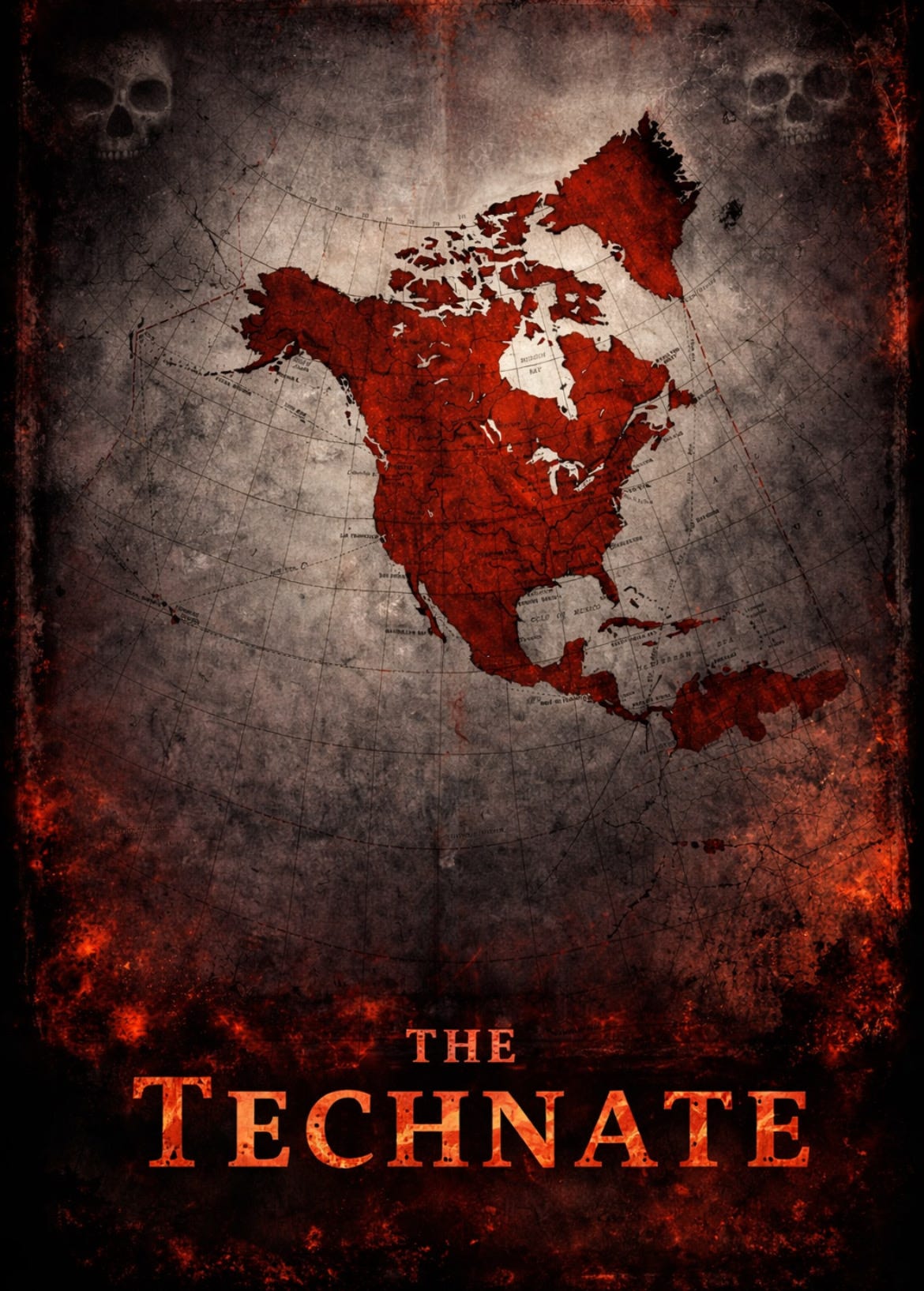
This is the prologue to “The Technate”, a novel about the collapse of America due to artificial intelligence and rising costs of living. People suffer a ‘soft genocide’, where slowly those who can’t keep up will die. Massive job losses with rising costs, such as gas, increasing property taxes, and rampant government corruption, all lead to instability. Even health care is too expensive for some to afford treatment. Things like insulin become more expensive to weed out those deemed ‘undesirable’. Based on Malthusian principles of population control, the elite have deemed that only those who can contribute and survive the ‘soft genocide’ stood to inherit the future. When society collapses, a New America will be formed by technocrats under an autocratic dictatorship, using mass surveillance to seize the entire Western hemisphere, and ushering a new era with the goal to propel humanity into the future.
This is fiction.
For now.